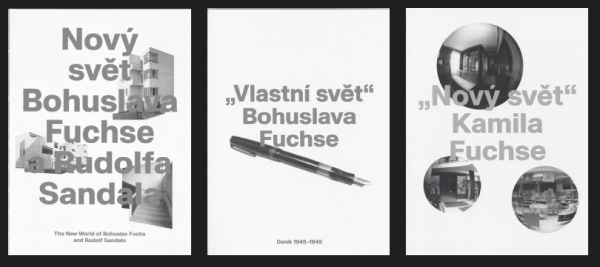
The New World of Bohuslav
Fuchs and Rudolf Sandalo /
Nový svět Bohuslava Fuchse
a Rudolfa Sandala, 2025
Chatrný, Jindřich, Kyrc, Filip and
Valdhansová, Lucie (eds.)
Muzeum města Brna
ISBN 978-80-88631-23-1
„Vlastní svět“ Bohuslava
Fuchse: Deník 1945–1949, 2025
Chatrný, Jindřich, Seitlová, Pavla
and Blazec, Zuzana (eds.)
Muzeum města Brna
ISBN 978-80-88631-33-0
„Nový svět“ Kamila Fuchse, 2025
Chatrný, Jindřich, Kyrc, Filip and
Valdhansová, Lucie (eds.)
Muzeum města Brna
ISBN 978-80-88631-26-2
The new World of Bohuslav Fuchs and Rudolf Sandalo
Bohuslav Fuchs is regarded as a leading figure of Czechoslovak functionalism and ranks among the most significant European architects of the interwar period. Examination of his work has assumed both partial and comprehensive perspectives, yet its extent has meant objective difficulties in contributing new knowledge or interpretations to the current state of research. The authors of the publication The New World of Bohuslav Fuchs and Rudolf Sandalo succeed in this aim through a specific perspective grounded in Rudolf Sandalo’s photography and the synergy of expressive artistic interaction.
The initial premise is that Sandalo’s photographs provide a vivid image of Fuchs’s intentions and ideas, allowing the viewer to the beauty of form and functional purpose of his buildings on the visual level. This connection was intended to become part of avantgarde culture as a mutually interacting architectural-artistic work. This perspective is clearly developed in the first textual part of the publication and represents its main contribution. In the second catalogue section, it is presented only pictorially without the support of verbal argumentation.
Following the introduction, the authors provide a chronological account of Fuchs’s work and life, highlighting the breadth of Fuchs’s creative oeuvre and the interweaving of architectural and urban challenges of Czechoslovak interwar production. In the catalogue section, however, they limit themselves solely to his architecture, in accordance with the concept based on presenting the visual artistic synergy of architecture and photography.
Sandalo’s work is characterized by “documentary objectivity” in the spirit of the German New Objectivity [Neue Sachlichkeit] (p. 17) and “a maximal description of the given architecture with a pure flow of the aesthetics of the International Style” (p. 19). Also noteworthy is the authors’ emphasis on the quality of descriptive geometry and photographic technique. At the same time, the authors do not hesitate to reveal Rudolf Sandalo’s objectively negative aspects – for example, his collaboration with the security forces under the Nazi occupation, or to discuss his artistically less valuable work in advertising and genre photography. The result is an authentic image of Sandalo as an individual, relieved of all excessive glorification. Yet the question remains as to whether the authors could have adopted a similarly critical approach toward Bohuslav Fuchs and verified his status as an avantgarde icon.
The second part of the publication takes the form of a survey catalogue of selected interwar works. Its structure follows chronologically, with key buildings emphasized through descriptions and explanations of the conceptual and formal changes in Fuchs’s architectural language. Presentation of these works is through photographs by Rudolf Sandalo and short descriptive texts by the authors. The texts provide basic identification and concise formal descriptions, identifying the innovative features in key buildings. Architectural interpretation and polemics are entirely avoided, and the authors provide no verbal support for the presentation of expressive artistic interaction between photography and architecture. As a result, the full potential of this interestingly conceived theme remains unfulfilled. The graphic design visibly alludes to avant-garde graphic design, without superficial shortcuts and retaining visual clarity. However, the cover design could have more inventively reflected the “New World” created jointly by Fuchs and Sandalo, shaped by the interaction of their architectural and artistic work. From this perspective, Fuchs’s authorial collage at the beginning of the introduction appears more convincing.
‘The New World’ of Kamil Fuchs
In the second volume, ‘The New World’ of Kamil Fuchs, the authors begin with a clear introduction conveying the almost poetic idea of creating a “new world” during the period of communist unfreedom and its distorted ideals of world-building, and the architect’s retreat into the free environment of the family cottage Nový svět [‘The New World’]. The introduction outlines the content, general concept and methodology, the authors’ viewpoint, and the potential contribution of the publication, which for the first time presents previously unpublished material and findings.
In contrast to the first volume, the authors construct a more authentic image presented through the chronologically contemporary perceptions of the professional public, personal and even expressive recollections of witnesses, and above all the opinions of Kamil Fuchs himself. Supplemented with explanations of the immediate contexts and the authors’ suggested evaluations, a more comprehensive picture begins to emerge.
The reason for this different approach also lies in shifts within scholarly interpretive strategies. Previous historiography focused narrowly on the most prominent figures of architecture, often uncritically idealizing them into iconic positions – Bohuslav Fuchs included. Contemporary historiography prefers a more critical stance, which the authors reflect in their view of the “ideologically unburdened” Kamil Fuchs. The authors go further than in the first volume: not only describing Kamil Fuchs’s work but also characterizing it and evaluating it, revealing the architect’s personal intentions, and drawing partial conclusions. Among various influences, the authors examine more closely the formative relationship the younger Fuchs had regarding the work of his renowned father and his exceptional artistic sensibility. Kamil Fuchs, they conclude, succeeded in emerging from his father’s shadow and establishing his own creative expression. The authenticity of his personal style was significantly shaped by his undeniable artistic talent, manifested in the artistic interpretation of architecture, primarily applied in interior design and monument restoration. This claim represents an important contribution of the publication, as it demonstrates the personal and creative strength of the architect’s self-identification. Similarly, the authors also do not avoid contesting the negative criticism, often unjustified and poorly substantiated, of Fuchs’s restoration of the Tugendhat Villa (1981–1985), convincingly citing its contemporary professional recognition – the award of the UN International Habitat Centre and the silver medal at the World Biennial of Architecture in Sofia (1987) (p. 12). They confirm the values of Fuchs’s now-lost restoration and implicitly align themselves with a shift in the professional paradigm regarding the protection of authentic restorations from the second half of the 20th century.
Through professional critique of his architectural work, supported by the characterization of a distinctive creative style and the revelation of Fuchs’s personal qualities, the authors arrive at a comprehensive image of the younger Fuchs. While appreciating his contribution, they nonetheless tellingly criticizing the present time, often unable to assess the quality of his work without prejudice toward the period in which it was being created.
‘The Own World’ of Bohuslav Fuchs
The volume ‘The Own World’ of Bohuslav Fuchs provides unique, previously unpublished biographical material from the architect’s personal estate. It contains information about his political-social, professional, and family life, as well as the broader domestic context. Divided into four parts, it consists of the architect’s personal diary (1945–1949); autobiographical curriculum vitae (1953); an appeal against persecution at the university (1958); finally a celebratory poem by his wife (1955). Differing in perspective and style, these texts create an authentically critical image of a little-explored phase of the architect’s activity during the complex times of postwar and early socialist consolidation. The contribution of the publication is all the greater in that, alongside this period, it also reveals neglected controversies involving Bohuslav Fuchs, thus critically revising his previously idealized image as an avantgarde icon.
Fuchs’s personal diary provides a subjective perspective, strikingly personal argumentation, and a distinctive style. Controversial statements may include his pointed critiques of respected personalities, institutions, and social phenomena, particularly his criticism of the architect Jiří Kroha (1893–1974), calling him the “national madman” [orig. národní blázen] (p. 157) and adding: “He has gone completely mad from that national artistry […] an exploiter of work, although he was never really an architect. These are almost anecdotes about how he leads the Stavoprojekt studios […].” (p. 155) The authors do not edit these emotionally charged comments for understandable reasons of authenticity. At the same time, they supplement the diary entries with a clear scholarly apparatus explaining the cited personalities, concepts, and realities, thereby verifying and contextualizing the personal opinions expressed in the diary.
Fuchs’s controversial and ambivalent attitude toward socialism is also remarkable. On the one hand, he sympathized with the idea of comprehensive socialization of the country and points to his own contribution to it; on the other hand, he criticizes the politicization of architecture – indicating an ambivalence that the authors could have further elaborated and clarified.
The third part, Fuchs’s appeal against his exclusion from the university, is an authentic testimony to the academic and social persecution of the 1950s. Forcefully responds to the Stalinist accusations, it describes his architectural and academic contributions, emphasizing his alignment with socialist values. The authors draw attention to this controversy in the introduction but might have developed it further.
Finally, the authors conclude with a stylistically and perspectivally balanced mix of content and form through a celebratory poem by Fuchs’s wife, Drahoslava, which artistically captures his personality in a few stanzas.
The volume ‘The Own World’ of Bohuslav Fuchs compensates for the absence of Fuchs’s postwar work in the first volume. However, the purely textual treatment avoids any visual presentation of his architectural output. Is this omission intentional on grounds of its deficient quality and form, which might, in the authors’ view, disrupt a possibly idealized image of Bohuslav Fuchs as an architectural icon? Or is the intention to present this period purely through the architect’s personal perspective, without visual distraction, to emphasize his thoughts, perceptions, and opinions?
Conclusion
In conclusion, the greatest contribution of the three-volume publication lies in its presentation of an engaging perspective on the expressive artistic interaction between architecture and photography in avantgarde art; in introducing the personal views and controversies of Bohuslav Fuchs through his authentic texts; and in the critical treatment of the work of his son Kamil Fuchs, whose contribution has long been overshadowed by his father. The expected impact of the publication lies in deepening public awareness of the figures and works of Czechoslovak interwar architecture and its cultural and social contexts, even if its relevance applies primarily to a narrower circle of professional readers.
Ing. arch. Matúš Kiaček, PhD.
orcid: 0000-0002-7936-6122
Institute of History and Theory of Architecture and Monument Restoration
Faculty of Architecture and Design STU Námestie slobody 19
812 45 Bratislava Slovakia matus.kiacek@stuba.sk

This work is licensed under a Creative Commons Attribution 4.0 International License