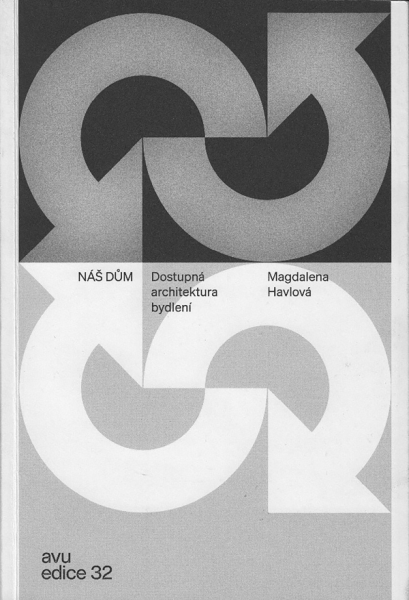
Náš dům: Dostupná architektura
bydlení, 2025
[Our House: An Affordable
Architecture of Housing]
Havlová, Magdalena S.
The Academy of
Fine Arts in Prague
ISBN: 978-80-88366-64-5
The reviewed text originally appeared as a doctoral thesis at the Academy of Fine Arts in Prague between 2018–2022. Like many recent texts of its kind, one of its leading sources of inspiration was the ever-increasing housing crisis especially affecting large cities in the Czech lands. The writer, who is an actual architect and not merely a theoretician of architecture, reflects the crisis and the associated lack of housing in a broader context, while drawing on her everyday practise from a Zurich-based architectural studio. Her approach is notably direct – she finds the contemporary state of things unsustainable and looks for inspiration and answers in the past, particularly in urbanistic solutions that have lasted be-yond the crisis of their immediate application. Moreover, thanks to their complexity and thoroughness, these realizations have revealed themselves as workable concepts that could, in the author’s opinion, contribute to the contemporary debate regarding housing and offer functional solutions. In particular, she highlights rental flats as an adequate form of housing, against the current consensus that renting is only a temporary stopgap for those without the capital to purchase their own property. Or, more accurately, to purchase a form of housing subjectively considered as their property, but in fact the property of the financial institution funding the purchase.
The volume opens with a glossary of the most frequent adjectives connected with housing and their brief definition: the reader is informed about rental, affordable, social, decent, city, cooperative and community housing, though of course several categories overlap. Three proportionately representative sections bear the respective titles “Essays”, “Images” and “Synopsis”. The part entitled “Essays” comprises eight chapters examining affordable housing in a historical perspective – what it means, who developed it a hundred years ago and who builds it now. Based on the author’s field notes, this section constitutes a certain mental map, accompanied by a wealth of illustrations. In her essay dedicated to the architecture of the home (pp. 22–30), she reintroduces into the debate the concept of the home as a place of “togetherness, mutual support and security”, which fundamentally forms both a general concept of architecture and its specific implementations. She also questions the influential statement that “people can live adequately only in such housing that they own” (p. 24) and draws attention to the mechanism of “embracing something as their own”, in many situations more important than legal ownership. Likewise, she points out that this mechanism surpasses the boundaries of the flat and involves the public or semi-public space surrounding the block of flats.
The essay discussing affordability poses the essential question of the objective of such housing: is it to achieve the possession or the rental of a home that will be stable and adequate pertaining to its tenants’ needs and income? She lists the methods and means available to individual agents such as legal norms, strategic urban planning or registry of empty buildings, but sidesteps the fact that their use is dependent on political will, not to mention the courage of the relevant parties to use them and likewise on the cultivation of shared values. In a society where most homes are owned, it is crucial to seek ways to restore the credibility of renting and to persuade the tenants that this option is not only economically viable, but also stable and promising a long-term future. The glimpse of Czechoslovak architecture between the wars offers some examples of fascinating quality housing blocks (e.g. the vanished clerical workers’ estate in Prague-Dejvice), yet it ignores privatism as a phenomenon which caught on in the late socialist era and took root in the new liberal times with growing intensity.
In a chapter titled “Developers and Builders”, towns and cities play the chief yet hardly exclusive role as investors of affordable and social housing. One image, featuring Vienna’s Karl-Marx-Hof (p. 42), might have deserved a more in-depth explanation, as it captures the fascinating phenomenon of so-called Red Vienna, the largest contemporary project dealing with housing crisis and unparalleled in its time. Between 1919–1934, the Viennese social-democratic government managed to build extensive, architecturally worthwhile blocks of flats for the lower-middle and working classes, and these estates still attract attention with their generosity and modernity.
One remarkable aspect of the volume is the author’s focus on the tower block (pp. 56–67). She discusses its definition, follows its changes over time and researches its incorporation into the city organism. In her opening lines, she points out one unsurprising but essential characteristic: from its emergence in the early 18th century until the start of privatisation in the mid-1990s, the urban block of flats was exclusively a rental type of housing. It has only been in the last thirty years that we have seen a radical change in this typical element of the city and its function: no longer primarily a place of living, but essentially a space to capitalise on one’s assets. The author pays no further attention to this turning point, but I personally believe it should stimulate future debate.
The essayistic part is concluded by a case study of cooperative-housing development in Zurich (pp. 94–104). Here, cooperative development is shown as a demonstrably sustainable concept, which, on meeting the necessary conditions (such as powerful support by the state), can resolve many problems of contemporary cities. The sustainability of the Swiss cooperative movement, free of political pressure and not subject to restructuring – a policy which was in some respect directly counter-productive where Czechoslovak cooperative projects were concerned – lies in its continuity.
In the section entitled “Images”, the readers can see for themselves the changing character of urban blocks of flats, developed by cooperatives and municipalities between the 1920s and 1980s. The original intention of the final section, “Synopsis”, had been to provide a specimen – an architectural study – of a housing cooperative in Prague, yet eventually, the writer decided for a more theoretical and general approach. In brief, her survey of topics is essential for the commissioning of public housing projects and urban planning, providing a manual for identifying ways to achieve affordable rental housing. This manual deals with location, or rather the relationship between the home and its environment; the plot, or building grounds and its parameters; the project’s construction, including its lifespan; the building’s environmental sustainability; exteriors both in the sense of the building’s immediate surroundings and the shared communal spaces inside; the frontage and its role for the immediate public space; and in greater detail, even the rooms of the flat with regard to the needs of tenants.
I find the monograph specifically valuable for Havlová’s way of thinking about architecture and its historical sources. She broaches multiple perspectives which, if not reaching extraordinary analytical depth, prove the importance of architectural tradition and its reflection and use for the contemporary notion of the life in the city, its development and care. I would also like to stress the volume’s high-quality graphic design and ample pictorial supplement with contemporary photographs, schematic drawings and designs.
Marta Edith Holečková
orcid: 0009-0000-7298-3083
Ústav pro soudobé dějiny AV ČR, v.v.i., Vlašská 355/9
118 00 Praha 1
Czech Republic
holeckova@usd.cas.cz

This work is licensed under a Creative Commons Attribution 4.0 International License