The present study examines a situation in which a work of architecture becomes a listed monument during the productive career of its author. Such instances are few but have begun to occur with greater frequency, considering the increasingly brief time between the completion of the work and its legal protection. The case study analysed is that of the Bratislava crematorium, built from the design of Slovak architect Ferdinand Milučký in 1969 and in 2003 declared a national monument as an artistically exceptional and internationally significant work. Milučký was known for his vehement defence of architects’ authorial rights, yet nonetheless largely accepted the monument status for his crematorium, which prevented any further interventions in the work. The study attempts to summarise the lessons arising from the divergence between this situation and that of earlier built monuments by authors no longer living, while bringing attention to the tension between the innovative tendencies of a living architect and the conservation-oriented nature of monument protection, along with the subjective motivations of the creator. Further, it highlights the gaps in current monument-protection and intellectual-property legislation and the possibilities for cooperation in monument care.

The “Death” of the Author
When Roland Barthes published his provocative article on the death of the author in 1967 and 1968,1 the construction of Slovakia’s first crematorium was reaching its completion in Bratislava. Barthes, of course, was focusing on literary criticism and made no explicit mention of architecture, yet his reflections on the importance of the observer and the retreat of the author could easily apply to it, as indeed to any creative discipline. After all, how many passers-by could even name the authors of the buildings around them, let alone what they thought and what stylistic language they wished to use? Indeed, many authors discussing architecture reacted to Barthes’s thesis and attempted to capture the influences that come to bear on architectural creation beyond the individual author-architect. Further worthwhile inspiration was provided in turn by the postmodernism of the 1980s.2
In the case of the architect of the Bratislava crematorium, Ferdinand Milučký (1929–2019), he was hardly close to death, whether in the literal or the metaphoric sense of Barthes’s formulation. He was young, at the peak of his creative force, and anything but shy as an architect-author. Quite the reverse: he put great stock in his authorship and throughout his career struggled to ensure the recognition of architects’ authorial rights.
Yet during his lifetime, Milučký was confronted with one moment that essentially cut him off from a work he had authored – in 2003, the Bratislava crematorium was declared a national cultural monument.3 It occurred still during his productive life and for the next decade and a half he took an active role in projects for the maintenance, restoration, and adjustment of this structure. A relationship entirely new and previously unprecedented: a living author and a built monument. What new situations arose from this status, and how did society and the specific architect react to them?
The Method
In acquiring the material for the present study, the primary method was to draw upon my personal conversations with the architect. Further information could be gained from statements that he provided to professional publications and the news media, from study of his personal sketches and blueprints, including the project for the crematorium’s restoration, which are preserved in the Slovak National Gallery and the Slovak Museum of Design in Bratislava. Also included in these archival funds are various documents or official complaints that reveal the architect’s struggle to ensure his own rights as an author. Further information was acquired from interviews with the deputy head of the monuments protection office when the crematorium was declared a national landmark, the director of the organization administering the building of the crematorium, and the current heiress to Milučký’s authorial rights.
Monument Status in the Author’s Lifetime
In the past, the centre of attention for the protection of built monuments initially involved buildings of anonymous authorship and several centuries – if not millennia – in age. Over time, the distance between the building’s origins and its monument status grew shorter, and their initiators emerged out of the depths of history as known personalities. And with further definition of monument protection, the subject of interest spread to ever more recent works. The same process can be seen in Slovakia’s practice, or respectively the heritage practices in Czechoslovakia and even earlier under Austro-Hungarian or Hungarian rule. In the later part of the 19th century, the predominant area for attention was the protection and restoration of the earliest built works from the Romanesque and Gothic eras.4 As the historical range of protection gradually expanded, the time lag between construction and preservation grew shorter. Even though the earliest buildings never disappeared as a subject of interest, they were gradually joined by newer ones and, by the last years of the 20th century, even ones only a few decades old.
In current monument-protection discourse, attention has been turned mostly to the specific questions of preserving recent architecture,4 rather than explicitly the work of living authors. Still, in cases when prominent architects had long lives, such as, for instance, Oscar Niemeyer (1907–2012), they experienced the overlap between their lifespan and the monument protection of their own works, observing “that a listed project belongs to the community and not to its author”.5 Other authors have noted that “today, architects and designers live longer than their buildings, and, essentially, we are arguing for the preservation of our own buildings”,6 hence similar moments of overlap will only be more frequent in the future.
The briefness of the interval is more likely for buildings where the monument value is based on collective memory – i.e., that of participants and buildings with a historical dimension. Such works can become protected sites not long after completion, hence with a high likelihood of their authors still being alive.7 As such, the sense of completion, closure, or officiality of these architectural works prevents the authors from any further intervention, in contrast to the greater bulk of architecture.
Of these works, there were only three in Slovakia that achieved monument status during their creators’ lifetimes before the case of the Bratislava crematorium.8 First, in 1963, was the Morava sanatorium from 1933 by Bohuslav Fuchs (1895–1972), yet the changes made to it prior to the declaration took place without involvement of the original author.9 Also in 1963, monument status was given to the town swimming baths in Košice from 1935 by Ľudovít Oelschläger (1896–1984); he, though, had been expelled to Hungary after 1945 and thus had no possibilities of influencing his work from across the border. Moreover, around three decades had elapsed before these buildings received heritage status, while the protection of modernist architecture turned out to be only a brief episode. Any truly systematic protection of modernist works came only toward the end of the century. It was in this period (1996) that the third such protected modern work became the Financial Palace in Žilina from 1931 by Michal Maximilián Scheer (1902–2000); again, the author, who was 94 years old at the time, had no further involvement with the building.10
Understandably, we cannot expect that the time between a building’s completion and its monument status will continue to shrink at such a rapid pace. Stabilizing the attribution of monument status requires a certain chronological detachment, which also involves detachment from the subjectivity of the author. Yet precisely the case of Milučký’s Bratislava crematorium saw the simultaneous and parallel appearance – partially in harmony and partially in disagreement – of the two principles of monument protection and authorial rights. How did this split manifest itself, and what conclusions can be drawn from it?


A Diminishing Interval
The shifting time boundary and the diminishing interval of distance were aided by the initiative leading to the founding of the international organization for protecting modern architecture DOCOMOMO and the start of its activity. Its primary goal was the documentation and protection of the Modernist movement, in other words of works from the interwar period. By the time of the organisation’s start (founding in 1988, first conference in 1990), around half a century had passed and the iconic authors were already deceased.11 Gradually, though, by the turn of the millennium its attention extended to newer works.12 In the regions of eastern Europe, however, its protection continued to be delayed, since there the legacy of postwar architecture remained “still connected to the ideology of the former regime, and thus rejected not only by the public but equally by the preservation field”.13 Yet even so, a shift did occur, as attested by the declaration of the Bratislava crematorium as a monument in 2003.
The Bratislava Crematorium and Its Author
Efforts to create the first crematorium building in Slovakia had a long history. Already in the 19th century, the Viennese association Die Flamme made plans to build a crematorium in nearby Bratislava. However, not even the left-wing parties in the interwar city council succeeded, and it was only with the official atheism of the Communist regime after 1948 that it became possible – though even so, with a delay of two decades.14
Indeed, the time when the final design for the crematorium was underway, the mid-1960s, was favourable for two parallel reasons: the official atheism of the regime and its increasing political liberaliztion,15 the tolerance of cremation by the Catholic Church after the Second Vatican Council, the maturing of architectural Modernism, the elan of the first graduates of the Slovak Technical University, and, for the artworks that form an integral part of the crematorium complex, an effort toward a uniquely Slovak national retelling of modernist principles.
Ferdinand Milučký was a member of the collective that produced the winning design for the Bratislava cemetery and crematorium in 195516 as well as the winner of the national competition for a funeral hall from 1964, though he had been working on the final project for the Bratislava crematorium since 1963. The architect was forty when the building opened in January 1969; though he created several other noteworthy buildings for the remainder of his professional career, the crematorium remained his crowning achievement.
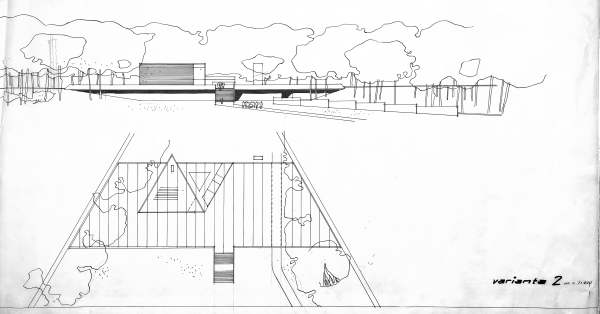
Milučký as an architect took great care and thoroughness in addressing all possible aspects of each project. For every design, he invariably tested a long series of possible solutions, creating many working sketches and variants. And this applied as well to the crematorium. The large glass wall in the front of the main hall was originally intended only as a side wall; in the final phase, he moved it to the façade, echoing the example of the university chapel in Otaniemi (K. and H. Siren). Undeniably, many of the approaches that Milučký used here had their precursors in the architecture of interwar or postwar modernism. He greatly admired the plan for Stockholm’s forest cemetery (E. G. Asplund and S. Lewerentz), along with the openness of Mies van der Rohe’s Barcelona pavilion.17 All these inspirations became originally transformed in his design.
The reason for recalling this complex history of the building’s development and the underlying authorial decisions behind the future work is that these factors continued to play a role in the author’s awareness, affecting his later decisions on how to treat his finished work once it became a monument. For older buildings by authors no longer alive, these matters would be entirely irrelevant.
Shortly after its completion, the crematorium won widespread praise and its author was awarded leading national prizes.18 “Today this ‘Gesamtkunstwerk’ that discreetly accompanies the path of the mourner is considered one of the icons of modernism in Slovakia.”19 Moreover, it was repeatedly discussed abroad, with Kenneth Frampton and Wilfried Wang including it in their selection of world architecture for 1900–2000.20 Pierre von Meiss stated “the great cemetery (and crematory) of Bratislava, inspired by Scandinavian forest cemeteries, stands as one of the most important architectural contributions of Communist-era Eastern Europe”.21 Or for Wolfgang J. Stock, “it is not only a masterpiece of Slovak architecture but of Modernism as a whole”.22
Monument status was assigned to the crematorium only 35 years after its completion. By this point, the architect was 75 but still active, and the city of Bratislava, as the building’s owner, turned to him to commission design projects for its maintenance, alterations, and restoration.
Minor Changes
Even previously, though, the architect had returned to the building and even made partial supplements to his design. For instance, shortly after the completion of the crematorium, he added a columbarium.23 Later, after the building was under monument protection, he prepared a restoration plan, correcting certain problems that had lasted since the time of construction or had arisen through natural wear as the building was used.
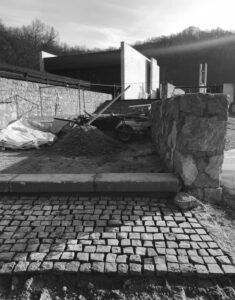
Several changes were necessitated by stricter construction standards, such as the raising of the low connecting balustrade on the terrace. For improved handicapped accessibility, a rear entrance was created and, because of the water seepage into the spaces below the terrace, the architect had to weaken his powerful modernistic idea of connecting the exterior with the interior; the original paving of small basalt cubes leading continually from the entrance through the ramp and the terrace up to the main hall facing the terrace was replaced with larger stones. With only rare exceptions, these changes were highly organic and indeed minor, leaving the wider architectonic concept unviolated. Only the replacement of the flagstones brought questions from the monuments board, but not an objection.

Not even further developments of funeral ceremonies or cremation technology implied significant changes, and whenever alterations became necessary, they were either adapted to the original concept or regarded as sufficiently self-evident that they could be carried out with the general consent of the user, the architect, and later even the monuments office.
Between 2006 and 2009, thus around four decades after the building’s completion and after its declaration as a protected monument, restoration took place following a project by the original architect himself. It corrected a few flaws persisting from the original construction (e.g., the poor-quality plating of the attic), damage ensuing over time (e.g., cracked tiling slabs), along with removal of various signs of age (polishing the slabs, renewing the original “glowing” colours of the wood panelling that had darkened across the years), and similar matters.
Several of these changes were not in full accordance with strict heritage preservation. For example, the removal of the traces of age on the limestone cladding meant, in Alois Riegl’s definition, “the value of the new” surmounting the “value of the old”.24 The definition of the “old”, nonetheless, remains a problematic one in the case of more recent buildings even among specialists,25 and the architect-author preferred to return to an original “newness”, in other words the condition of the object at the moment of its creation. And in turn, for the user as well any defects from wear and aging can themselves be an essential problem or even hindrance.
While the restoration took place under supervision of the monuments office, the dominant factor remained the personality of the architect and heritage supervision entirely secondary. Milučký consistently followed any subsequent interventions in other works of his and always vociferously demanded the right to design them personally. Considerable struggles occurred over the right to design alterations to the embassy buildings in Moscow and Rome, where he shared authorship credit jointly with architect Jozef Chovanec. And he took particular care to ensure he never lost the authorial chance to design the renovations to the crematorium, a building near where he lived and could attentively follow its condition. Still, the greatest conflicts came with the crematorium’s operator regarding the removal of an old oak tree, which the architect had used as a focal point of the composition in planning the end of the access route.
The changes undergone by the crematorium and the columbarium before as well as after its official monument designation, in which the architect was involved to a greater or lesser extent, can be classed into four groups.
1) First: the expected and natural changes that add to the value of age (growth and maturing of trees, patina on the walls and stone cladding);
2) Second: divergences from the original design or returns to it (changes to the flagstones of the terrace, the return of the previously removed statue “Sorrow” [Smútok] to the urn grove);
3) Third: changes brought by technical progress, whether small (replacement of worn components or fixing of errors in the original structure) or large (replacement of the crematorium ovens).
4) Fourth: changes for humanization and increased user comfort (the rear access route, the farewell room by the crematorium ovens, the raised balustrades).
Most of these changes can be regarded as natural and even if they imply alterations to the original state, they are treated as if self-evident. In general, the building’s user insisted on changes concerning function and technology yet also took a critical view of certain problems with the original architectural design that significantly affected its immediate everyday use. And these changes were proposed often in direct conflict with the architect.
Authors’ Rights vs. Monument Status
The question of monument preservation is equally urgent on the international scale, with significant application to monuments in terms of architecture.26 The Slovak Monuments Act27 focuses on the earliest stratum of built monuments, where the question of direct authorship often has no bearing and authors’ rights thus would never be invoked. For architecture, it specifies only that such restoration of architectural heritage is allowed that would “neither threaten, nor damage, nor destroy”28 – with ho implication that the original author of the work might even be involved. And indeed, when the crematorium was declared a monument, Milučký was not counted among the persons affected, nor was there any provision that he would be formally delivered the announcement of its status.
In the Slovak Copyright Act29, which is comparable to other intellectual property legislation in Europe,30 the question of authorship rights in architectural works is mentioned only in passing. Moreover, neither of these cited laws addresses the special situation when an author has the ambition, or is directly commissioned, to alter or change their work. Per the formulation of the Copyright Act, the owner or another user of a building may “undertake without the author’s agreement only such structural alterations and maintenance work as are unavoidable for maintaining it in good condition and for preserving the functional use, and which do not lower the value of the architectural work”31, yet never stating explicitly that the right to design these alterations should be given to the original author.
Between these positions, though, exists a certain tension. The monument-protection approach is grounded in retaining the original parameters, preferably in conjunction with retaining the original function, while the creators’-rights approach assumes the right for the original creative freedom to allow for subsequent authorial intervention and a change within the work. Yet the latter is willing to accept monument protection, which usually is applied several decades later, implying the need for restoration and the emergence in the interval of new demands for the object. The question remains as to what extent legislation should reflect the problematics of the relation to the living author of the monument – though it unquestionably should take this situation into account and assume that the author should be a participant in the decision on monument status.
In turn, the uncertainty around individual authorship remained a cause, under the political system before 1989 which focused more on the collective than the individual, of dissatisfaction among architects regarding the protection of their authorial rights. In fact, among architects Milučký was a significant proponent in his lifetime of ensuring authorial rights not only for his own works, but as a general principle for the rights of other architects.32


A Monument after the Death of the Author
Understandably, after the (physical) death of the author, all rights to make changes in the work, which the original architect as author could have implemented, come to an end. Succeeding them, though, is the point of inheritance of intellectual property rights, a matter that gains further complexity when the holder of these rights is a qualified architect as well. And such is the case with Milučký, whose heir became his widow, architect Júlia Kunovská. Her views became decisive in the first major controversy after Milučký’s death, involving the request to install a cross inside the grounds of the urn grove. The crematorium operator stated that he had personally spoken to the architect at the end of his life and that he allegedly was willing to consider the addition, even though the crematorium had been created as an entirely secular concept and was devoid of any religious symbols. Yet when the plans were made for realization, Kunovská announced her opposition to it, stating that she had never known her late husband to have given any sign of agreement. After several further statements of objection, the crematorium management eventually dropped the idea.33
Still, it is not inconceivable that the architect may have considered installing a cross – considering that during his restoration project (2006), he proposed for the main hall an unassuming portable cross. It must be said that he always understood his work as continually open to his own authorial interventions, unlike those who regarded his work as a completed artefact and a monument-protected building. For them, the addition of a cross was not merely a formal superfluity, but in principle a contradiction of the original idea and formulation of the crematorium.
Conclusion
The case study of the Bratislava crematorium, which we have considered here as exemplary, may indicate certain instructive points, yet it should be admitted that the case is unique. As such, the conclusions need not prove universal and several of them may be inapplicable. Indeed, even the constellation of monument and living author is, and is likely to remain, exceptional. Still, we should summarize those points that seem to hold objective validity:
1) Considering the increase in humans’ average and productive ages and the shrinking gap in proclaiming architectural works as monuments, it can be assumed that more cases are likely to occur.
2) Authors are likely to welcome monument status as the crowning acknowledgement of the qualities of their works, yet at the time of their creation such a possibility is far beyond the horizon of interest, particularly for such an innovative and ahistorical modernist work as the Bratislava crematorium is.
3) Declaring an architectural work a monument is a matter that architects tend to take quite personally, while monument experts usually view it as the absorption of the work into the care of the entire community while the individual creator remains marginal.
4) If authors regard monument status as a personal award, they consequently tend to claim the right to make changes in the object, in this instance citing authorship or intellectual-property rights. Of course, their activities are limited by the interests of the building’s owner, where the dominant questions are practical ones, yet these best highlight the weak points of the object and point out how to correct them.
5) Monument institutions can acquire an ally in the original architect, who has a detailed knowledge of the object and, unlike a deceased author, has the right under intellectual property law to enact changes in it. Experts in monument protection may likely lack such extensive information and can thus be at an argumentative disadvantage with respect to the work’s originator.
6) Authorship rights in this case, though, should be proportionally limited.
7) Tensions can arise if authors oppose the strict protection of the original design in the event of changes of opinion, new experience, reaction to stylistic changes, or desire to correct errors.
8) In creating their designs, architects made a series of essential decisions and selected from a large array of possibilities, which could lead to the belief that even under monument protection, they should have the right to make innovations and changes. This belief, though, stands in direct opposition to the practice of monument protection in preserving a single specific design and a unique built object.
The object of the Bratislava crematorium, which became a national monument while its author was still living and creating, provides several stimuli for reflecting on what circumstances surround a monument of this unusual type. In this text, we have pointed out those that differ from the case of monuments with a deeper history and indicated conclusions that could help provide protection in such a rare case, yet one hardly impossible in the future.


The paper was created at the FAD STU in Bratislava as an outcome of the research project Monument Values of Architecture in the Second Half of the 20th Century: Identification and Methods of Protection and Return to Scale and project The Architects Harminc and Milučký Between Tradition, supported by the VEGA agency (Grant no. 1/0063/24) and the KEGA agency (Grant no. 040STU-4/2024).
BARTHES, Roland. 1967. The Death of the Author. Aspen, 3(5–6); and the French version: BARTHES, Roland. 1968. La Mort de l’auteur. Manteia, (5).
EBERT, Carola. 2007. Post-mortem: Architectural Postmodernism and the Death of the Author. In: Anstey, T., Grillner, K. and Hughes, R. (eds.). Architecture and Authorship. London: Black Dog Publishing, pp. 40–49.
The crematorium was declared a cultural monument by the Ministry of Culture of the Slovak Republic on 28 August 2003, following the proposal by the Monuments Office of the Slovak Republic from 30 July 2003. No objections were lodged by any of the involved parties, and the city of Bratislava as the building’s owner also agreed. In the justification, it was stated that the crematorium is a “…significant document of architectural development, …achieves qualities of European significance, …has exceptional aesthetic-architectural and urbanistic values”. Evid. no. 9323, MK 4087/2003-400. The Monuments Board of the Slovak Republic (hereinafter PÚ SR).
Current discourse on this topic addresses, among other issues, the ambivalent situation between acknowledgment of heritage and physical destruction: MACHATA, Igor. 2024. Preservation Issues of Architecture from the Second Half of the Twentieth Century. Architektúra & urbanizmus, 58(1–2), pp. 36–53; iconoclastic tendencies aimed at late-modernist buildings toward the end of their life-cycles: SZALAY, Peter. 2013. Memory and History: Protection of Architectural and Urban Heritage from Slovakia’s Totalitarian Eras. In: MORAVČÍKOVÁ, H. et al. Modern and/or Totalitarian in the Architecture of the 20th Century in Slovakia. Bratislava: Slovart, pp. 112–113; preservation of traces of radical innovations: KURIC, Alexander. 2025. The Steel House: A Short-Lived Episode of Prefabricated Housing in Interwar Czechoslovakia. Architektúra & urbanizmus, 59(1–2), pp. 121–139; or the linking of monuments to contemporary life: MELKOVÁ, Pavla (ed.). 2022. Živá památka. Living Monument. Prague: The Prague Institute of Planning and Development; JELÍNKOVÁ, Martina. 2023. (Re) vision of Monument Care? Architektúra & urbanizmus 57(1–2) pp. 149–153.
DIAS COMAS, C. E. 2018. Heritage Agencies and the Conservation of Brazilian Modern Masterpieces: A Partial Report. Built Heritage, 2(35–49), p. 39. doi: 10.1186/ BF03545692
PRUDON, Theodore. 2017. Preservation, design and modern architecture: the challenges ahead. Journal of Architectural Conservation, 23(1–2), pp. 27–35, here p. 27. doi: 10.1080/13556207.2017.1327193
For instance, these include the Slavín Memorial in Bratislava completed in 1960 by Ján Svetlík (1912–1997), declared a monument 23 October 1963, or the Slovak National Uprising memorial and museum in Banská Bystrica from 1969 by Dušan Kuzma (with Jozef Jankovič, 1927–2008), which became a monument only three years after completion (26 January 1973).
The other instances are the town market in Žilina by Ferdinand Čapka (and Mikuláš Šesták) and the church in Partizánske by Vladimír Karfík, both of which became monuments in the years of their primary authors’ deaths – respectively 1987 and 1996.
The later alterations were designed by his son Kamil Fuchs.
The most recent information on these objects was published by MORAVČÍKOVÁ, Henrieta et al. 2024. 101: Slovenská architektúra v registri DOCOMOMO. 101: Slovak Architecture in the DOCOMOMO register. Bratislava: Čierne diery.
F. L. Wright died in 1959, Le Corbusier 1965, L. Mies van der Rohe 1969, W. Gropius 1969, R. Neutra 1970, K. Melnikov 1974 and A. Aalto 1976.
HENKET, Hubert Jan and HEYNEN, Hilde (eds.). 2002. Back from Utopia. The Challenge of the Modern Movement. Rotterdam: 010 Publishers.
MORAVČÍKOVÁ, Henrieta, SZALAY, Peter, ANDRÁŠIOVÁ, Katarína and BARTOŠOVÁ, Nina. 2013. Identita a diferencia: monitorovanie a hodnotenie najvýznamnejších diel modernej architektúry na Slovensku. Identity and Difference: Monitoring and Evaluation of the Most Significant Works of Modern Architecture in Slovakia. Architektúra & urbanizmus, 47(3–4), pp. 144–169, here p. 148.
DULLA, Matúš and TRIAŠKA-STEFANOVIĆ, Olja. 2017. Na konci cesty: krematórium v Bratislave. Bratislava: Slovart.
As mentioned by Moravčíková: “Ironically, this specific combination of totalitarian organization and artistic freedom indeed permitted architects to expand their limits and create an individual and conceptionally perfected body works.” MORAVČÍKOVÁ, Henrieta. 2007. Late Modernism in Slovakia. Expanding the limits. In: Hurnaus, H., Konrad, B. and Novotny, M. Eastmodern. Architecture and Design of the 1960s and 1970s in Slovakia. Wien/New York: Springer, pp. 190–195, here p. 192.
This was an expansion of the cemetery in Slávičie údolie and the authors of the winning design, under the title “Urna 8” were: Ambróz, Červeň, Fašang, Kopernický, Lacko, Milučký, Šipkovský and Škorupa. RB. 1955. Posúdenie súťažných návrhov na ústredný cintorín a krematórium v Bratislave. Projekt 1(1), pp. 2–4.
Dulla, M. and Triaška-Stefanović, O., 2017.
For this, the architect received the Czechoslovak State Prize and the Prize of the Union of Slovak Architects; in 1970, a survey of architects in the national architectural journal Projekt declared the crematorium to be the best Slovak postwar architectural achievement.
HURNAUS, Herta, KONRAD, Benjamin and NOVOTNY, Maik. 2007. Eastmodern. Architecture and Design of the 1960s and 1970s in Slovakia. Wien/New York: Springer, p. 185.
FRAMPTON, Kenneth and WANG, Wilfried. 1999. World Architecture 1900–2000: A Critical Mosaic. Volume 3. Northern Europe, Central Europe and Western Europe. Wien/New York: Springer.
MEISS, Pierre von. 2013. Elements of Architecture. From Form to Place + Tectonics. 2nd ed. Lausanne: EPFL Press and Oxford: Routledge, p. 190.
STOCK, Wolfgang Jean. 2004. Architekturführer: christliche Sakralbauten in Europa seit 1950. Architectural guide. Christian sacred buildings in Europe since 1950. München/New York: Prestel, p. 297.
It was created in 1974 for significant representatives of the workers’ and Communist movements.
“Neuheitswert” versus “Alterswert”. RIEGL, Alois. 1903. Der moderne Denkmalkultus. Sein Wesen und Seine Entstehung. Wien: W. Braumüller.
H. Moravčíková et al. have stated that monument experts, against architectural theorists of the later 20th century, have a tendency to evaluate the old higher. Moravčíková, H., Szalay, P., Andrášiová, K. and Bartošová, N., 2013, pp. 144–169.
The activities of UNESCO in the area of declaring architectural monuments on the international level, which has a high reputation in national frameworks.
Zákon Slovenskej republiky č. 49/2002 Z. z., Zákon o ochrane pamiatkového fondu.
Zákon Slovenskej republiky č. 49/2002 Z. z., p. 15.
Slovenský autorský zákon č. 185/2015 Z. z.
TURANCOVÁ, Miriam. 2008. Autorský zákon v architektúre. ASB, 23 October 2008 [online]. Available at: https://www.asb.sk/aktualne/ autorsky-zakon-varchitekture (Accessed: 22 October 2025).
Slovenský autorský zákon č. 185/2015 Z. z., č. 57, p. 2216.
At the congress of the Union of Slovak Architects in 1983, he presented a discussion contribution entitled “Art and the Investment Process” (Fund F. Milučký, Umenie a investičný process, typescript, 8 p., 6 November 1980. Slovak National Gallery.) and in 1984 prepared an outline that, among other subjects, proposed the mandatory inscription of the author’s name on the realized work, along with a request for differentiating artistic and technical work and specifying methods for inviting the author for necessary changes in a building. (Fund F. Milučký, Architektúra a autorské právo, typescript, 4 p., July 1984. Slovak National Gallery.)
This discussion was covered by MOČKOVÁ, Jana. 2020. Do areálu krematória v Bratislave mal pribudnúť kríž… Denník N, 21 October 2020 [online]. Available at: https://dennikn.sk/2099014/ do-arealu-krematoria-v-bratislave-mal-pribudnut-kriz-po-zasahu-vdovy-po-ferdinandovi-miluckom-ho-tam-nedaju/ (Accessed: 6 November 2025).
DOI: https://doi.org/10.31577/archandurb.2026.60.1-2.3

This work is licensed under a Creative Commons Attribution 4.0 International License