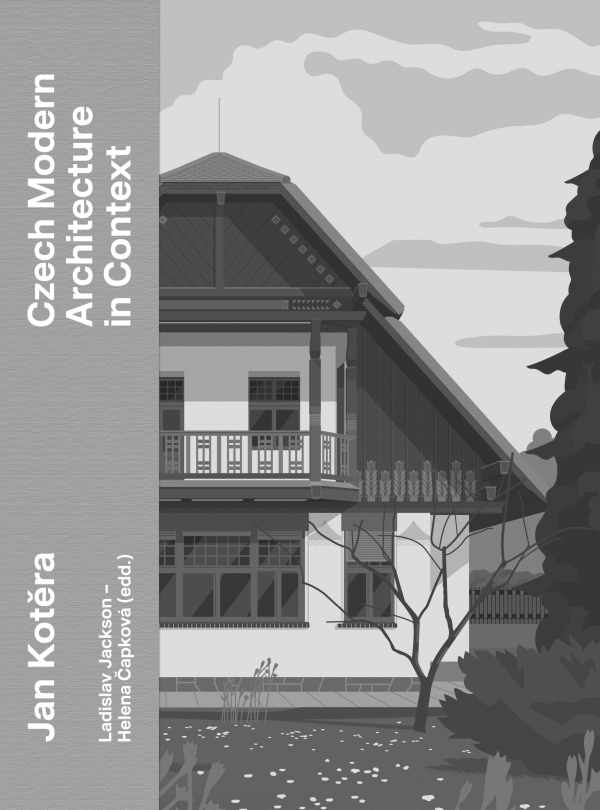
Jan Kotěra: Czech Modern Architecture in Context, 2025
Jackson, Ladislav and Čapková, Helena (eds.)
Pravý úhel
ISBN 978-80-907128-6-7
In his book Mladí Mistii: Architekti ze školy Otto Wagner na Moravě a ve Slezsku, Jindřich Vybíral singled out Jan Kotěra as “the most important of Otto Wagner’s Czech students”.1 It is certainly true that Kotěra was one of the leaders of the Wagnerschüler in his time at the Academy of Fine Arts in Vienna. Jože Plečnik, a close friend, referred to him as the “center” of the school.2 And the Viennese critic Ludwig Hevesi, then one of the loudest voices calling for reform, counted Kotěra among the most gifted of the young architects of the day, alongside Joseph Maria Olbrich, Josef Hoffmann, Plečnik, and Leopold Bauer.3 In later years, as Ladislav Jackson and Helena Čapková write in the new book on Kotěra which they co-edited, Kotěra is often accorded the status of the “founder of modern Czech architecture” (p. 10). A bold statement, and an easy one to take at face value. But what does it mean? To what extent did Kotěra forge a new architecture? In what ways could that architecture be seen as distinctly “Czech”? And, perhaps most crucially: how should we interpret
Kotěra and his work now?
The answers to these first two questions are closely linked. After attending the building trades school in Pilsen, Kotěra went to Vienna, where he studied with Wagner. A few other Czechs took the same path, most notably Pavel Janák. But Kotěra’s time at the Academy occurred almost a decade earlier, just prior to the formation of the Vienna Secession. It was then that the discourse about modernism was still crystallizing, when the dominant issue concerned how to adapt the Art Nouveau to Central European reality. Kotěra had a significant part in advancing this discussion, promoting the possibility of a distinctly Czech variant of the new style. Nor was this fact lost on his contemporaries. Karel Mádl wrote of Kotěra in 1899: “We saw in him a new, truly new, force rising, as necessary for the Czech architecture of this time as salt in bread, so that it would no longer suffocate in artistic conservatism, which elsewhere has already been overcome.”4
But Kotěra’s reception when he returned to Prague was not all he could have hoped for. His first important work, the Peterka House, was the target of withering criticism. Josef Hlávka, reacting to its soft, flowing lines and smooth surfaces, reportedly remarked, “Well then! That’s our savior from Vienna. It looks like a dog ‘licked’ it!”.5 Others assailed the building for the opposite reason, charging that it was too much like Wagner’s “international” aesthetic – overly geometricized and purified.
One could read Kotěra’s work over the next decade as his reactions to these criticisms. Several of his designs, including the Trmal and Rýdl villas, borrowed directly from Czech folk forms – as if he were seeking approval after straying too far into Wagner’s orbit. Some of his other works, in turn, seemed attempts to find a more “neutral” basis. His District House in Hradec Králové directly referenced the local language of the late Baroque, even while including Czech vernacular forms. And the National House in Prostějov offered a somewhat confused mélange of historical elements – Baroque again, but also Biedermeier – ornamented with a distinctly “Czechified” version of the reigning Secessionist style. It was not until around 1908 that Kotěra began to find his way toward a distinctly modern form-language, an early version of functionalism. The Laichter (1908–1909) and the Urbánek (1911–1913) buildings, both in Prague, suggested possibilities for a new architecture reliant on simplified massing, reduction, and the direct expression of construction and materials.
Yet what is noteworthy about Kotěra is that even after adopting this novel and compelling form of modernism, he continued to experiment with a welter of other ideas. His Museum Building in Hradec Králové retains some of the constructive language of his two Prague buildings of those years, but it looks toward a rereading of classicism, one that would eventually evolve into Art Deco. And Kotěra’s late works, most notably the Law School of Charles University, directly reference the Národní styl, or National Style, albeit in a rather personal way. It is an uneven legacy.
What is especially admirable about the essays in this book is that they seek to interrogate this rather problematic history. Each of the chapters sets out specific issues or problems. Jan Galeta examines Kotěra’s relationship with Historicism, arguing that he rejected the old eclecticism but continued to embrace the idea that the past still offered meaningful lessons for the present; Martin Krummholz takes on the subject of Kotěra’s fifteen-year-long relationship with the sculptor Stanislav Sucharda, which in Krummholz’s assessment helped to shape “the broader cultural and social environment of the Czech art world”; Vendula Hnídková discusses Kotěra’s often-frustrated efforts at developing garden cities, observing that he eventually turned to “more socially stratified models” for housing; and Markéta Žáčková investigates Kotěra’s engagement with city planning, concluding that his “most significant contribution” lay “primarily in his role as an organizer of professional life and the founder of a specialized architectural school”.
Ladislav Jackson, in one several essays, takes on Kotěra’s role in developing and perpetuating the postwar National Style [národní styl]. What he writes is particularly perceptive: “In his designs for the government institutions, Kotěra did not adhere strictly to the codified canon of modern classicism, nor did he align with the overly decorative concepts of the national style. His vision for representing Czechoslovakia was more nuanced: he sought a synthesis of forms that were both local and universal.” That sophisticated synthesis, he adds, “was destined to fade”. The reasons for this are all too clear: not only did Kotěra’s “synthesis” lack legibility , as it said little directly about the aspirations of the new state, but it was swept away by the tide of functionalism that followed soon after his death. Very quickly, his work began to appear passé. What is evident now in hindsight is that Kotěra’s main role was less that of a form-giver than a spiritual guide, and especially an educator. Two of the book’s essays, by Jana Sklenářová Teichmannová on Kotěra as a teacher at the School of Decorative Arts (now the Academy of Applied Arts) in Prague, and Jackson on Kotěra’s time at the Academy of Fine Arts, assess this aspect of his legacy. At the School of Decorative Arts, Kotěra taught more than sixty members of the coming modernist generation, including Adolf Foehr, Otakar Novotný, and Josef Gočár; at the Academy, he taught Bohuslav Fuchs and Adolf Benš. Kotěra notably refused to accept women as students, but he was very good at teaching his chosen male students, not only imparting to them a high degree of skill but also an enthusiasm for embracing the problems of contemporary life and addressing them in architectonic terms. Above all, he served for them as a cultural mentor and seer.
The last set of essays in the book focuses on Kotěra’s impact outside of Czech context. Helena Cox describes his reception in Great Britain, observing that he was deeply interested in the English country house tradition, though in this he was hardly alone in the Central Europe of those years; Helena Čapková, in an especially original essay, writes about Kotěra’s student Jan Letzel and their joint relationship to Japan, noting that Kotěra’s connection was mostly at arm’s length; Jackson discusses Kotěra’s trip to the United States in 1904 to install the Czech exhibits in the Austrian pavilion at the World’s Fair in St. Louis and his reactions, which were mostly “reserved” but showed a general openness to American design, and particularly the work of Frank Lloyd Wright; Miroslav Pavel looks at Kotěra’s relationship with contemporary Dutch architecture, concluding that the architect was chiefly influenced by the Dutch reliance on brick and brick patterning; and, finally, Jackson, in another essay, explores Kotěra’s projects for the “south Slavic regions”, including his unbuilt spa buildings for Opatija, Dubrovnik, and Grado, a bank building in Sarajevo, and the Imperial Palace in Belgrade.
None of these last projects advanced what Kotěra had already achieved in the Czech lands, but their designs highlight one of the central issues in Kotěra’s oeuvre: a certain untimeliness. As Jackson writes, these works perfectly aligned with the “grandiose, luxurious” aesthetic of the late Habsburg Empire, a world that even then, in those last years before the war, was already losing its relevance. Kotěra spent his career preaching the idea that architecture had to respond to the needs of the present. Yet the trenchant irony was that the answers he proffered to the problems of modernity were quickly superseded. In that sense, he was closer to Olbrich, who similarly soon passed out of fashion, than, say, Janák, who adapted to the changing currents, or Adolf Loos, whose architecture and interiors, if sometimes fustian, predicted what was to come. Kotěra was indeed important for the rise of Czech modernism. He was always, as Plečnik had suggested, a “center”. But it was what spun around or from him, his students, his messages about modernity and modernism, his spiritual and cultural presence that had much to do with his importance. This book offers an important corrective, setting out a more nuanced and broadened view of his impact.
Christopher Long
Martin S. Kermacy Centennial Professor Architectural History
School of Architecture University of Texas at Austin 310 Inner Campus Drive Austin, TX 78712
USA
chrlong@utexas.edu
2026
VYBÍRAL, Jindřich. 2002. Mladí mistii. Architeki ze školy Otto Wagnera na Moravě a ve Slezsku. Prague: Argo, p. 123.
Vybíral, J., 2002, p. 123.
HEVESI, Ludwig. 1906. Acht Jahre Secession. Vienna: Carl Konegen, pp. 137–138.
MÁDL, Karel B. 1899. Příchozi umění. Volné směry, 3(9), p. 119.
“No tak! To je ten spasitel z Vidně! Jako by to pes voblízal!” ČTK. 2023. Jan Kotěra – zakládající osobnost moderní české architektury. Archiweb [online] Available at: https://www.archiweb. cz/n/domaci/jan-kotera-zakladajici-osobnost-moderni-ceske-architektury#:~:text=archiweb.cz%20%2D%20Jan%20
Kotěra%20%2D%20zakládající%20osobnost%20moderní%20 české%20architektury (Accessed: 5 May 2026).

This work is licensed under a Creative Commons Attribution 4.0 International License