This paper examines the headquarters buildings of the Communist Party of Slovakia as a distinct type of administrative structure developed during the late socialist period, particularly in the 1970s and 1980s. Drawing on archival sources and fieldwork, the paper situates the Party secretariat buildings within the broader system of centrally planned investment construction and examines the role of the Communist Party as investor. Through analysis of projects both realised and unrealised, the study explores the evolution of this building type and argues that its political character derived primarily from its institutional-pragmatic function, rather than its symbolic-representational one.
Introduction
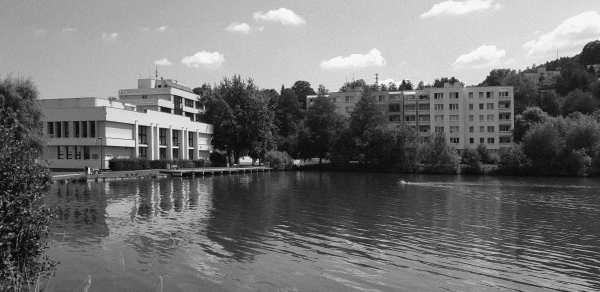
Before the shift of political focus to the federal and republican parliaments in the final years of the Czechoslovak Federation between 1989 and 1992, the centres of political power were the secretariats of the Communist Party.1 Despite this prominent role, the circumstances surrounding the building of their headquarters are still unknown. In the public perception, they remain present either through media shorthand as curious manifestations of “socialist megalomania”, or have blended into their surroundings through adaptation to new functions. Most of them have, in fact, been repurposed and now serve as schools, municipal and district offices, and other public institutions.
To capture the forms of the Secretariats of the Communist Party of Slovakia [Komunistická strana Slovenska, KSS] as a specific building type within the typology of administrative buildings in their entirety, I focus primarily on the 1970s and 1980s. This final period of the communist regime is also referred to as state socialism or normalisation.2 In the aftermath of the suppression of the democratisation and liberalisation efforts of the Prague Spring, a series of changes took place at the political, economic and social levels over the following two decades. The Communist Party of Czechoslovakia [Komunistická strana Československa, KSČ] consolidated its monopoly on power as the state party, exerting its control on life in Slovakia through its subordinate organisation, the KSS. The regime strictly regulated the population’s participation in public life but allowed a certain degree of freedom in the private sphere. At the same time, a range of pro-social measures was expanded to mitigate societal dissatisfaction (e.g. housing construction, support for personal consumption, pro-natalist policies, and pension increases).3 Normalisation in Slovakia was distinguished by personal continuity of the Slovak political elite,4 more selective persecution than in the Czech lands, and an absence of organised resistance against the regime.5 The regime was also “more effective in integrating larger parts of society into official structures”.6
In the first part of this study, I present the Party as a political organisation with its own structure and processes, focusing on aspects related to its involvement in investment construction. In the second part, I turn my attention to specific completed building projects, as well as unrealised plans. To capture the full spectrum of this building type, I include in the analysed material not only the masterpieces of post-war modernist architecture, but also more conventional projects. My predominant interest is the context in which the need to build these buildings arose. Where did the plans and requirements for construction originate? How did Party secretariats evolve as a specific type of administrative building in Slovakia? And what role did the pragmatic nature of the function and material conditions play in the final architectural form? My primary source material is from the fund of the Central Committee [Ústredný výbor, ÚV] of the Communist Party of Slovakia (KSS), held at the Slovak National Archive.7 To ensure further context from the central perspective, I use selected documents from the funds of the Central Committee of the Communist Party of Czechoslovakia (ÚV KSČ), 1945–1989, held at the National Archives in Prague.8 Part of the design documentation and correspondence included comes from local archives in the regions where the construction of the specific building took place.
The operation of the state construction sector and the projects termed “investment construction” [investičná výstavba] in Czechoslovakia has recently been examined primarily through the lens of state design institutes, which, as general designers, were responsible for design and engineering work.9 To complete the picture of the organisation, administration, and production of construction, which was based on a centrally planned economy, with five-year plans in place, this paper examines the role of the investor. Until now, this role has been addressed in the literature merely by noting the state’s monopoly position without further examination. Yet the role of the client, patron, sponsor or investor is a traditional and indeed highly meaningful theme in the history of art and architecture.10 In line with this tradition, I am therefore interested in examining the commissions, the resulting solutions and the specific conditions in which the process of creating and establishing a new building type took place.
Previous research focusing on architecture created for the KSČ or the KSS has concentrated primarily on buildings other than their own workplaces.**key=11* These studies have also tended to focus more on issues of heritage conservation or interpretations within the context of an architect’s individual work. So far, the only comprehensive overview of the Communist Party of Czechoslovakia secretariats in the Czech lands has been provided by Miroslav Pavel’s research.12 In addition to their formal characteristics, Pavel also examines these buildings’ function. He argues that the secretariats were originally intended to symbolise “the power of the ruling party, which was supposed to help maintain and spread the officially proclaimed ideology”.13 In line with the views of the architects,14 who regarded their works as the depoliticized outcomes of a creative response to assignments “from above”, Pavel subsequently perceives the secretariats as “mere administrative buildings”.15 According to Pavel, the administrative function takes primacy over the political-representative one.
Only in exceptional cases have the KSS headquarters received specific attention. Selected buildings were included in analyses16 or lists17 of architects’ works in monographic publications. In the broader historiography of 20th-century Slovak architecture, only minimal reflection was given.18 Even architectural discourse during the period in which these buildings were erected did not address this building type in sufficient detail. Party administrative buildings were mentioned mainly in the context of their urban integration into the emerging modern city centres.19
The most recent contributions to the subject thus consist of works that examine selected buildings, with a primary focus on the possibilities for their architectural restoration and adaptation.20 Building on previous research, I aim to examine the full spectrum of this specific type of administrative building in Slovakia. At the same time, I also highlight the political dimension of this architecture, yet not in the traditional sense of representing the regime, when the ruling political force sees a suitable expression for legitimation of its power in specific architectural forms or styles. The political nature of this architecture, I argue, emerges more from its primary function and the activity of the client (the Party) that commissioned the project.
Political Meaning of Architecture
In her research into the relationship between the state, politics and architecture, the Hungarian sociologist Virág Molnár uses examples from post-war Hungary and (East) Germany to emphasise the active “power to transform the built environment” rather than “representational power” of architecture.21 According to Molnár, this “power to transform the built environment is instrumental in shaping the social organization of everyday life and the functioning of social relations”.22 I understand the Party’s ability to reshape the built environment from a position of power as a sign of the instrumentalisation of architecture to fulfil political goals. This involved creating a stable internal structure comprising a party apparatus, a membership base and its associated material and technical infrastructure spread across the entire country.
For other types of buildings, such as houses of culture [domy kultúry], the development of form within its prescribed typology was, at least at the discursive level, shaped by the Marxist–Leninist ideological framework. This is not the case with party headquarters. No official conceptual programme or any discussion ever appeared in ideological writings, whether architectural or political, addressing the aesthetic and expressive character of party headquarters architecture. Discussions among the leading party bodies on the architecture were largely limited to considering whether to reuse an existing design for the new secretariat building or to create a new one.23 For this reason, I believe that political instrumentalisation did not occur through the lens of an ideology that was to be “materialised” in the architectural form through which it could present itself, rather as more of a pragmatic move to create an extensive bureaucratic network of workplace facilities providing the material basis for the consolidation of political power.
Organisation and Structure of the KSS
Until February 1948, the KSS was formally an independent political party. Following the state takeover in February, the existence of two political entities, the KSČ and the KSS, was viewed as undesirable and superfluous. The new totalitarian communist regime was based on strict centralism, including within the party leadership. Following the Soviet Union’s model, the KSČ operated as the only leading force. The KSS became its subordinate regional organisation, responsible for developing and adapting the centre’s directives and requirements to the conditions and territory of Slovakia. However, it formally retained its name, held its own congresses and had its own party apparatus, mirroring the organisational structure of the KSČ.24 This asymmetrical political model persisted throughout the entire communist regime.25
The party was organised according to territorial and production principles. Under the territorial principle, the organisational structure corresponded to the territorial jurisdiction of regional and district National Committees [krajské a okresné národné výbory], including their head-quarters. The industrial principle permitted the formation of party organisations in workplaces, factories, and en-terprises. These organisations, in turn, were subordinate to larger ones whose jurisdiction covered a given part of the territory – specifically, the district and regional organisations.26
Changes to the organisational structure of the KSS took place in 1960. In accordance with Act No. 36/1960 Coll., three regions were established in Slovakia: Western Slovakia, Central Slovakia and Eastern Slovakia (with the governing centres in Bratislava, Banská Bystrica and Košice), in which regional committees of the KSS began to operate. The Municipal Committee in Bratislava retained the powers of a regional committee.27 Following the establishment of the Czechoslovak federation in 1969, responsibility for the territorial division passed to the national councils. Act No. 71/1969 Coll. briefly abolished the regional national committees in Slovakia, dividing the territory into 37 districts and a separate unit comprising the capital city, Bratislava. However, Act No. 130/1970 Coll. re-established the three original regions and confirmed Bratislava’s status as a separate territorial unit at the regional level. This organisational structure, with 11 district committees of the Communist Party of Slovakia operating in the West Slovak Region, 13 in the Central Slovak Region, and 13 in the East Slovak Region (each with a regional committee at its centre), formed the basis for the overall territorial distribution of party secretariat buildings.
The Party Apparatus
Although the party’s congresses and the bodies elected at them (such as the Presidium and the Secretariat) were formally regarded as the Party’s supreme institutions, the “party apparatus” [stranícky aparát] also played an important role in the system. This term referred to the communists employed by the Party in its bodies and institutions. However, the term could also refer to the system of party secretariats and facilities.28 In terms of power, it was the party leadership’s most important tool.29 Jan Pešek likened the party apparatus to a kind of “shadow government”,30 which replaced and acted as a substitute for other government bodies, such as national committees or ministries. Its staff constituted the most stable element of the party’s active membership. The apparatus enforced the Presidium of the Central Committee of the Communist Party of Slovakia’s resolutions on a national scale, coordinating and supervising the activities of all institutions in all areas of society. When implementing the Presidium’s decisions and guidelines, the apparatus either delegated tasks to lower party levels and non-party institutions within its jurisdiction or monitored their implementation. However, the group was hardly homo-geneous. In parallel to the Party as a whole, the apparatus staff were organised in two hierarchical ways: vertically, according to the level of the party body and their position within a specific department, and horizontally, according to their professional classification. Furthermore, the members were divided into political, administrative and technical staff, with political staff being the highest in the hierarchy and the most numerous.31
By the end of 1948, only 137 paid political employees were working in the district committees of the KSS. However, numbers grew in the following years, reaching a peak of 1,733 employees within the KSS structure in 1955.32 By 1960, this figure had declined to 1,102. The era of normalisation, linked to the need to “consolidate” power and create a resilient apparatus, was also reflected in a renewed increase. By the end of 1976, the Party employed 1,713 people in political positions,33 and by the end of 1987, this figure had risen further to 1,800.34
Alongside the increase in staff numbers, the number of Party members rose sharply during the period of normalisation. Even before 1968, membership growth in Slovakia had at times (e.g. at the turn of 1959–1960), been faster than in the Czech lands.35 This process reached its peak in the mid-1970s, when membership rose rapidly to almost 320,000.36 Although the pace slowed in subsequent years, the KSS’s membership base continued to grow. By 1986, it had reached 425,000. This represented approximately 12.5% of the adult population, or one in eight citizens of Slovakia.37
While the communist authorities were satisfied with merely external displays of support for the regime from ordinary citizens, Party members were expected to demonstrate activity.38 In the early 1970s, when the Party was dealing with the pro-reform remnants of the Prague Spring and strengthening its internal ideological unity through purges,39 active political work was required of communists, matched by the expectation that communists would play an even more significant role than before in organising and managing economic and social life. This active role of the Party in all aspects of everyday life was supported by the resolutions of the “normalisation” 14th Congress of the KSČ in 1971 and is referred to in most reports justifying the need to erect new party buildings. Apart from this ideological cliché, however, the reports and building proposals contained no other claims associating architecture of the Party headquarters with the representation of communist power.
Shortly after Gustáv Husák took office as the First General Secretary in 1969, the Party authorities began to address the passivity of the membership. They criticised the low attendance at meetings and “the reluctance to establish traditional units, such as evening schools, self-study seminars, study groups and lecture series, as well as other forms of Party work”.40 The intensification of activities was to be achieved through regular attendance at members’ meetings, where specific tasks would be assigned to each communist.41 These requirements were also reflected in the designs of party buildings: in addition to offices and smaller meeting rooms for individual departments, they also included a large meeting room, break areas with a fully equipped canteen, a dining room and classrooms, as well as offices for lecturers. Larger buildings also had a lecture hall equipped with cinema projection. Part of the buildings were set aside for the operational needs of coinvestors, e.g. offices, classrooms, and staff rooms for the Socialist Youth Union or the Trade Union organization. Technical areas were supplemented by storerooms and day and night rooms for the People’s Militia.
The greater emphasis on Party education was also linked to efforts to encourage communist activity. In 1971–1972, a three-tier education system was introduced with the establishment of the new Faculty of the Political Institute of the Central Committee of the Communist Party of Czechoslovakia [Vysoká škola politická pri Ústrednom výbore KSČ] in Bratislava.42 However, there was still a shortage of lecturers at regional and district levels. The theoretical and methodological training of lecturers, propagandists and agitators was to be provided by party educational facilities, such as houses of political education [domy politickej výchovy, DPV], which were established as part of the District Committees of the Communist Party of Slovakia (OV KSS) structure, as well as political education cabinets [kabinety politickej výchovy, KPV], which were to operate within primary organisational enterprises.43 Many more DPVs and KPVs were to be added to those already established in Bratislava, Košice, Nitra and Banská Bystrica44 in Slovakia. The aim was to ensure that political education centres were operating at all district committees by 1975.45
Administrative tasks associated with implementing the directives and tasks of the central KSČ in the regions and districts of Slovakia, enhancing the ideological “quality” and expertise of party members or those awaiting admission to the party, their preparation for political work and propaganda activities, meetings, congresses and conferences – all this formed the programme of a party that required physical spaces for its activities.
Investment Policy
In 1984, Ján Šváb, the First Secretary of the Economic Department of the ÚV KSS, listed all the Party’s investment construction achievements. He expressed his conviction that, by the end of the 9th five-year plan (1986–1990), every regional, district and municipal party committee would have its own building. These plans were not overly ambitious. At that time, construction of the largest party headquarters was either underway or nearing completion, and many district branches had already been operating in new buildings for several years. A Communist official could therefore proudly claim that the leadership, headed by the First General Secretary, Gustáv Husák, had ensured that fellow party members and the entire party apparatus “have the necessary working and technical conditions for their responsible work in building a developed socialist society”.46 From the early 1970s onwards, alongside a new concept of Party education, investment in the building of secretariats for regional, district and municipal party committees became a key part of the agenda for strengthening the party’s own structures.
No general construction programme with a legislative base existed to determine where and on what scale party buildings were to be erected. However, the resolutions of the Secretariat of the ÚV KSS, which approved building proposals, medium- and long-term investment plans, and the party’s budget for the relevant years, provide insight into the genesis of the buildings from the investor’s perspective. Construction was also based on investment plans drawn up by the intended users of the buildings (e.g. a district party committee). To ensure a unified approach among all party bodies when preparing new buildings, the ÚV KSS issued the “General Guidelines for the Preparation of Investment Plans”47 in 1972. This document defined the contents of proposals for the construction of a new building, as well as the indicative financial cost and justification for construction (i.e. why the older existing party headquarters are unsuitable), while further including a preliminary architectural design of the building and a definition of the basic building programme (number of rooms and staff, functional requirements) – among them, the basic volumes, the spatial and operational relations, the layout, as well as anticipated constructions and materials. It is at this stage of the investment construction that closer cooperation between the client and the design institute can be observed.48
The building proposal, often accompanied by the initial architectural design, was first submitted to the economic department of the related regional party committee for approval. It was then forwarded to the ÚV KSS, whose Secretariat submitted it to the ÚV KSČ. Subsequently, the power “flowed” downwards again from the top.49 The regional party committees (KV KSS) were the direct investors responsible for construction, securing subsequent project stages and obtaining building permits from the relevant state authorities, while the ÚV KSČ was always considered the general investor within the investment actions. On the other hand, the ÚV KSS served more as a formal intermediate stage or representative of the ÚV KSČ and had little influence on decision-making.50 If the district branch submitted a complete proposal well in advance and had secured an architect and contractor, the process ran smoothly. However, the nature of communication between the different hierarchical levels of management remains unknown. Only fragments of materials have been preserved from the meetings and committees that assessed construction plans. Nevertheless, monitoring the development of individual projects shows that the approval of the first architectural design by the KSČ, and its subsequent inclusion in a specific five-year construction plan, did not automatically guarantee adherence to the planned start and completion dates. Within the context of the socialist construction sector in the 1970s, which prioritised the mass production of housing, delays were not unusual. Apart from the supply chain, this was also evident in the design phase. For instance, the project for the new Bratislava III Local Committee of the Communist Party of Slovakia (ObV KSS Bratislava III) secretariat was suspended temporarily and subsequently completed late because the state design institute Stavoprojekt Bratislava had to prioritise other design works relating to the housing estate in Petržalka.51 The same reason was behind the delay in completing the Zvolen OV KSS building.52 Even new administrative buildings for party apparatus were considered less important than the completion of a large number of flats.
Financing of the construction of the secretariats is closely linked to the growth of the Party’s assets. The KSS was financially dependent on the KSČ. A single, centralized budget was utilised for the operational expenses of the Party apparatus, with allocated resources directed, for example, towards employee salaries, propaganda activities, or investment initiatives. The KSČ had obtained its assets primarily through the confiscation during the nationalisation process immediately after 1948. However, these assets were subsequently sold to the state in the 1950s. Even the properties sold by the Party continued to be used for its own purposes.53 The agreement concluded in 1971 between the KSČ and the Ministry of Finance of the Czechoslovak Socialist Republic was intended to resolve the unclear situation regarding property rights.54 Under this agreement, all KSČ and KSS buildings completed by the end of 1971 were to be transferred to state ownership.55 The agreement also established a set of rules for buildings whose construction began after that date. Although the construction was initially financed primarily from the Party’s budget, or that of other organisations which shared the building, it did not become the Party’s property. Immediately upon completion, the building was transferred to the ownership of the relevant national committee, in accordance with the economic contracts concluded, and therefore belonged to the state. However, the state in turn refunded the Party the costs by the state and gave it the new building for free, permanent use.56
The construction of new secretariats in Slovakia reflected the KSČ’s investment policy. According to the KSS’s proposal for the 1965 financial budget, the increase in subsidies from the ÚV KSČ to the ÚV KSS was to be based on a reassessment of Slovakia’s political needs, improvements in construction capacity, and the favourable economic situation of the KSČ.57 From 1965 onwards, KSS investment increased, with construction accounting for the largest proportion: a direct result of the plan to build two new district committee secretariats in the towns of Topoľčany and Michalovce in 1965.58 In the following period, further new buildings were added, and construction investment grew.
Architecture of the Party Secretariats
Based on a comparison of investment plans and field research, it was possible to identify a total of 38 newly built KSS secretariats. Most of these were built during the fifth and sixth five-year plans, covering the periods 1971–1975 and 1976–1980, with 10 buildings completed in each phase. These primarily correspond to the headquarters of the KSS district committees, though larger, architecturally superior buildings are also among them, providing space for several state bodies and other organisations: e.g., the administrative building in Banská Bystrica (Ján Hanzel, 1967–1972), which housed the Central Slovak Regional Committee of the Communist Party of Slovakia [Stredoslovenský krajský výbor KSS] and the Central National Committee [Stredoslovenský KNV], and the Combined Administrative Building in Trenčín completed in 1977 by architect Alexander Lipták, which housed the OV KSS alongside the district and municipal national committees. Compared to the Czech context, the party secretariat as a building type emerged earlier.59 One reason could be that fewer potentially suitable older buildings existed in Slovakia that could provide long-term accommodation for secretariats; its building stock was smaller and probably in poorer condition.
The statistics do not capture several key factors. Firstly, the number of secretariat buildings does not fully reflect the Party’s territorial organisational structure, as the number of organisations with the authority of the KSS district committees was greater than the number of districts. Further, the situation in Bratislava was unique. Its original five district committees were replaced by the Municipal Committee of the KSS, holding the rights of a regional committee, and a subsequent reorganisation resulted in the creation of four local committees [obvodné výbory, ObV] with the rights of the district committees.60 This complex organisational structure is in contrast to only two known new-build party secretariats – the ObV KSS building in Bratislava’s third district (Bratislava III Nové Mesto) and the OV KSS Bratislava-vidiek building located in the Ružinov district (1981). As such, the unsatisfactory spatial conditions of the Bratislava party authorities were likely addressed by relocations within the existing city infrastructure, as in the case of the secretariat of the OV KSS Bratislava IV, which was moved from a residential building in 1973 to the high-rise building of the Danube River Basin organisation in the Karlova Ves district.61 The Central Committee, the highest body of the KSS, was based in a nationalised, late-functionalist building dating from the 1940s.62 Additional construction work here was limited to the expansion of meeting rooms and garages, as well as later refurbishment. Most investment in new buildings was thus directed outside the capital of the Slovak Socialist Republic.
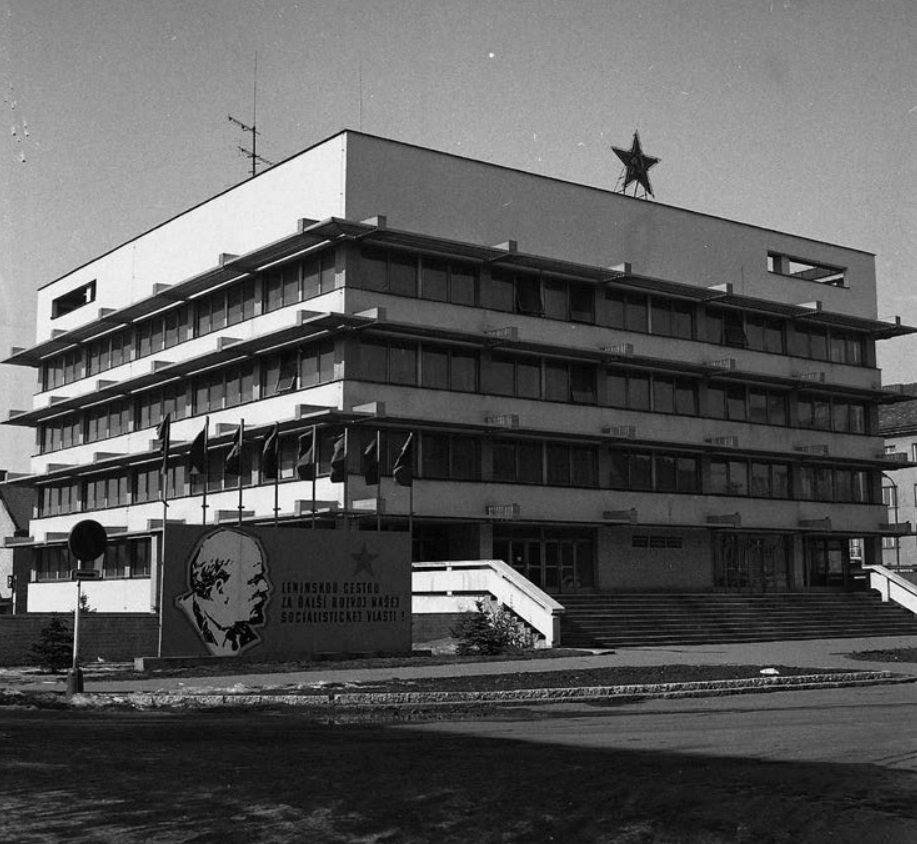
A second factor influencing the number of new buildings is that some district committees acquired two new buildings for their operations: the case of the district committees in Humenné and Michalovce, where standardised administrative buildings had already been constructed in the 1960s. Due to the expansion of the party apparatus, an overall increase in the number of Party members, and investment-driven development, new building activity was subsequently undertaken in these locations.
Finally, extensions and alterations related to the expansion of meeting rooms or changes in the buildings’ functions, particularly the addition of houses of political education, constitute a category of their own, in their alteration of the character of the original structure to a greater or lesser extent. In cases where only part of the building’s form was altered, the completion date of the main secretariat building is used as the timeline indicator (Humenné). However, where the extension involved adding new functions to the secretariat itself in new volumes, the date of completion of the extension is prioritised (Galanta). It should also be noted that none of these buildings have been demolished. The exception is the unfinished OV KSS secretariat in Žiar nad Hronom, where construction was interrupted by the regime change in 1989, and is therefore not included in the total count.
Overall, the construction of secretariats can be divided into three phases.
- The turn of the 1950s and 1960s is still associated with relocations and repairs. From the mid-1960s, however, separate new buildings began to emerge, though still belonging more to the field of anonymous construction rather than architecture.
- The first half of the 1970s featured ambitious plans for large administrative complexes in regional cities, but these plans were only partially realised. The “material and technical base” for the communists’ active work thus became, above all, a network of secretariats in district towns. Even when using a repeated form, buildings for the needs of the OV KSS were individually designed by architects for a specific site, with a clearly defined programme and separate operation of the secretariat’s office spaces, social areas, and other associated functions, such as the House of Political Education.
- The 1980s represent a peak of this building type, when the most architecturally complex and expensive works were created, with the principle of administrative blocs and a separate volume of the meeting hall now firmly established. In parallel, the number of Party members and employees also reached its highest point.
The Beginnings
In nearly all proposals concerning either the relocation of the OV KSS to a different building or the renovation or construction of new headquarters, a key point is the poor spatial conditions for the functioning of the party apparatus, as reported by lower-level party organs to their superior bodies. The layout difficulties associated with the location of offices in old historic objects or typologically unsuitable residential buildings are mentioned.63 District committees also complained about the lack of infrastructure for social activities, as there were no venues in many district towns with sufficient capacity for meetings and congresses.64 Another complaint included the lack of storage for materials, presumably including munitions and weapons, for the party’s armed wing, the People’s Militia.65
The secretariats of the district committees of the KSS often depended on buildings primarily housing the district national committee (ONV) or other administrative buildings from various sectors.66 Initially, the party’s investment policy focused on renovating or relocating its secretariats, or on expanding existing buildings, in order to resolve this unsatisfactory situation.67 It was only later that new building projects were undertaken.
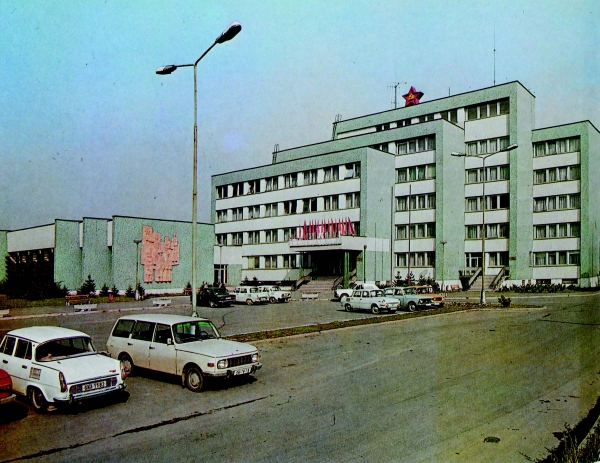
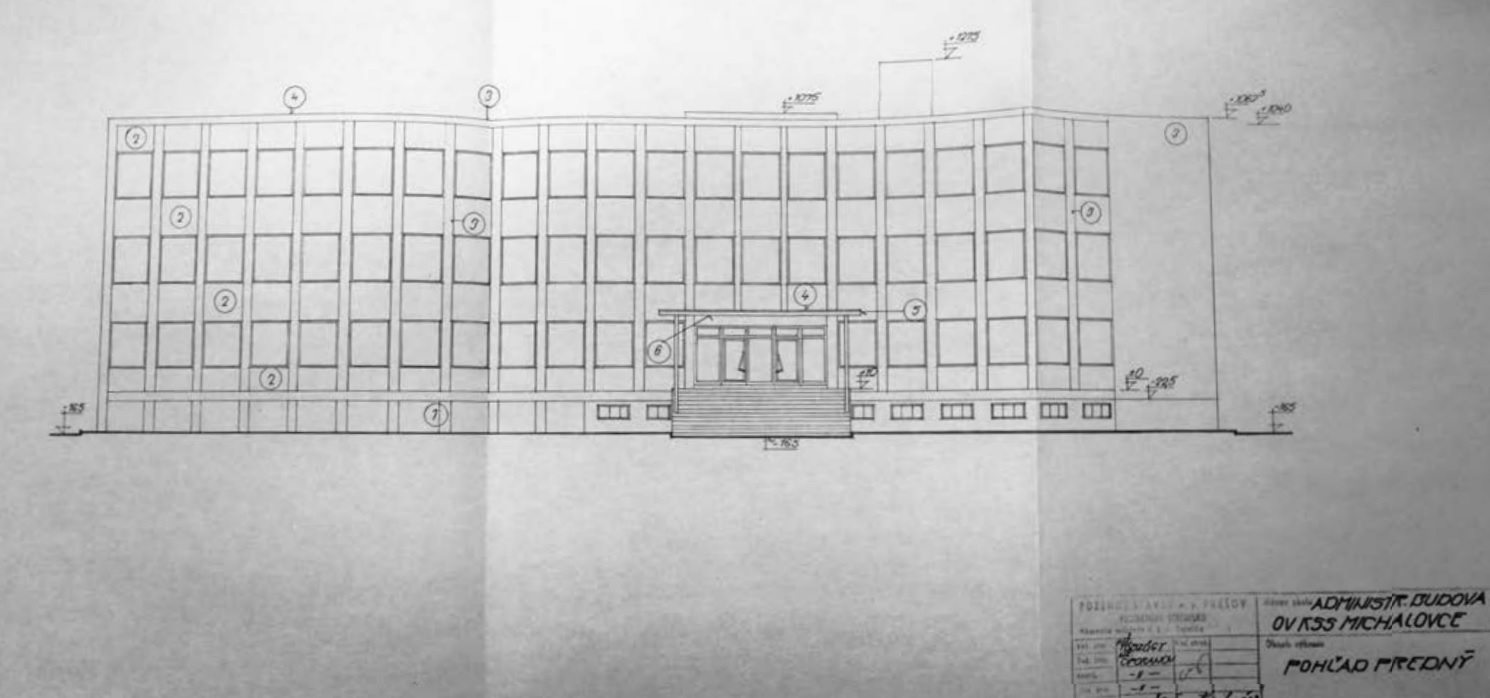
The first68 specifically constructed secretariat of the OV KSS, completed in 1964 in the city of Humenné,69 was a utilitarian two-storey building with a flat roof and no meeting room.70 Without any architectural ambition, it was simply the most practical solution for office spaces. The secretariats in the city of Michalovce, Svidník and Bardejov were designed similarly, using the form of a horizontal three-storey block with a three-wing layout, with the ending rooms designated as meeting rooms. Although standardised guidelines for the design of the OV KSS buildings probably did not exist, in contrast other building types such as houses of culture or department stores, the result was still the same type of administrative building.71 However, it was not until the design by Ivan Adda, architect and then-director of Stavoprojekt in Nitra, that a shift towards an architectural and urban planning approach can be observed. His secretariat in Topoľčany, dating from 1966, was no longer merely a single utilitarian building, but formed part of a conceptual scheme for the urban development of the new district town.72 It should be noted, however, that at this stage the buildings were low-cost (around 2 million Czechoslovak crowns) and designed for a small number of employees.
Repeated Designs
In 1969, the art magazine Výtvarný život [Artistic Life] published a “proposal for a type of administrative building for the OV KSS in a district town” by architect Karol Paluš.73 With its square floor plan, simple glazed façade and entrance vestibule, the building was reminiscent of Paluš’s earlier project, the Research Institute of Construction Economics and Organization in Bratislava.74 These 1960s-style forms are evident in the completed building of the Zvolen District Committee of the Communist Party of
Slovakia (1974), which was designed by Paluš’s colleague from Stavoprojekt Bratislava, architect Juraj Švaniga. The square layout with a central atrium and administrative offices around the perimeter, the emphasised horizontality supported by sunshades on the façade and the characteristic raised parapet are all traits that reflect the original “Paluš-style” type. Soon afterwards, the secretariat at the eastern end of the republic was also completed. At the OV KSS in Stará Ľubovňa (1972–1975), Švaniga repeated the familiar forms of his previous design featuring ribbon windows and aluminium cladding, but in a simpler conception without sunshades.
In addition to the building in Stará Ľubovňa, other district towns also acquired new party headquarters during the 1970s. In 1972, the ÚV KSČ decided to build a new OV KSS building in Humenné,75 which was designed by architect Pavol Merjavý from Stavoprojekt Košice. Construction began in 1973 and was completed in 1975; its design was later adapted with minor modifications for the party building in Spišská Nová Ves (1974–1976). These buildings consisted of two functional parts: simple, recessed administrative blocks and a separate structure housing a large meeting room, mutually connected by a lobby with a small atrium. While in Humenné, both the administrative and meeting room sections were in a single line along the main road, in Spišská Nová Ves, the perpendicular connection of the meeting room to the administrative block created an entrance area open towards the planned new town centre, where the construction of the secretariat marked the beginning of further development. Thus, the architect created a repeatable design that could be used in various urban contexts.
Major Investments in High-Rise Buildings: Regional Administrative Centres
The second half of the 1960s brought the beginning of construction on large and expensive architectural projects of national significance. In Bratislava, construction of a complex of government administrative buildings designed by Ivan Matušík began in 1965.76 Three years later, the first phase of the Trade Union House complex was completed in the form of a high-rise administrative tower. The trend of administrative buildings designed as high-rise structures with lightweight cladding reached its peak with the construction of the state authorities’ building in Považská Bystrica and the Slovak Television building in Bratislava (both began in 1968).
In the building climate of these major projects, which were intended to transform the appearance of Slovak cities, the KSS was also involved as an investor, alongside ministries and other state institutions.
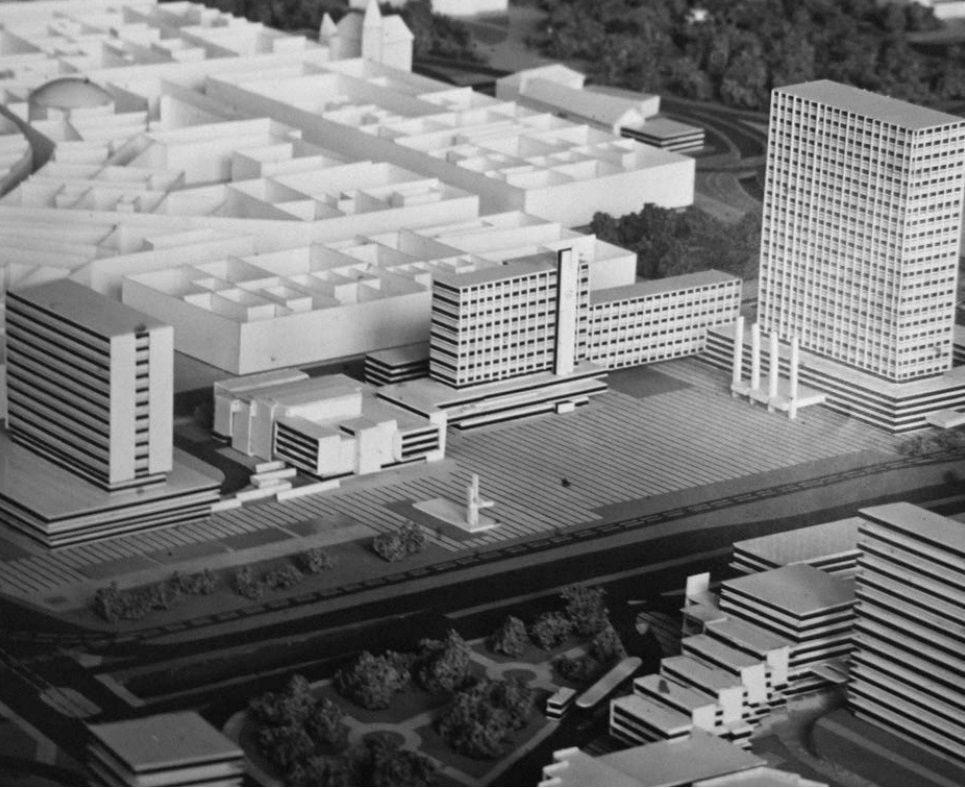
Discussions about concentrating the “scattered” party and state bodies in the centre of the Eastern Slovakia Region into a single location emerged as early as 1966.77 At that time, the city of Košice was gaining regional significance as the metropolis of eastern Slovakia due to its industrial development and growing population. However, plans for the new centre, intended to provide necessary space for local national committees and party secretariats previously housed in rented premises or unsuitable buildings belonging to other organisations, were delayed due to uncertainty regarding the territorial organisation of the state administration and unclear funding allocations.78 Hence the conceptual design for the construction of a political and administrative centre in Košice, created by the architects and urban planners of Stavoprojekt Košice, was not produced until 1972.79
In a prominent section of the square, which directly adjoins the heritage area of the historic centre, a plan was devised to bring all the administrative offices together into a single complex. Alongside the area’s existing land-mark, a high-rise hotel, a complex of interconnected administrative buildings was to be developed, including a conference hall and spaces for national committees, culminating in a high-rise party building. Its two-storey plinth would have housed a large-capacity meeting room, offices for regional national committee and the House of Political Education; in turn, the 22-storey section, formed by a steel structure combined with a light-weight aluminium-glass cladding, was intended to serve all levels of party bodies (the Regional, Municipal and District committees of the KSS). However, in addition to the pragmatic urban planning consideration of free space in other parts of the city, the new political and administrative centre emphasised strong ideological content right from the very beginning. The site of the square – “Square of the Liberators” [Námestie Osloboditeľov] with its 1945 monument to the Soviet Army, situated near the historic centre – was a prominent symbolic feature of the area. Hence the new architectural design, which “will reinforce the ideological and political character of this gathering space with its commemorative structures”,80 was in line with the normalisation pressure to fill public space with ideologically appropriate content.81 Moreover, a dominant party building enclosing the open space of the square with its mass would signify symbolic control of the city’s silhouette. However, conflicts over architectural and urban planning overshadowed ideological precision. The expert report from the Ministry of Construction and Technology not only commented on the layout, but also openly criticised the very nature of the building’s scale and form. To cite the commentary on the project brief, “[g]iven the disproportionate mass of the dominant central building, the human scale is lost in terms of spatial understanding. While the administrative centre must be considered a new organisational element of the future city, the excessive size of the volumes and spaces will negatively impact the city, affecting both the skyline and the creation of urban spaces and elements.”82
The criticised “schematic nature of the dominant structure”, which leads to its “amorphousness”, clearly challenged the previously established design of a slab base with a high-rise block on top. Though the high-rise monoblock was to be built as part of the complex’s phased development, with work due to begin as early as 1975,83 this vision was never realised. It is possible that, in addition to the financial constraints, the abandonment of the concept was also due to an architectural reevaluation of the “high-rise approach”, which was gradually replaced by other forms. This change became evident later in the new project for the party headquarters in Košice and other cities, where the KSS secretariats adopted a more horizontal arrangement of volumes.
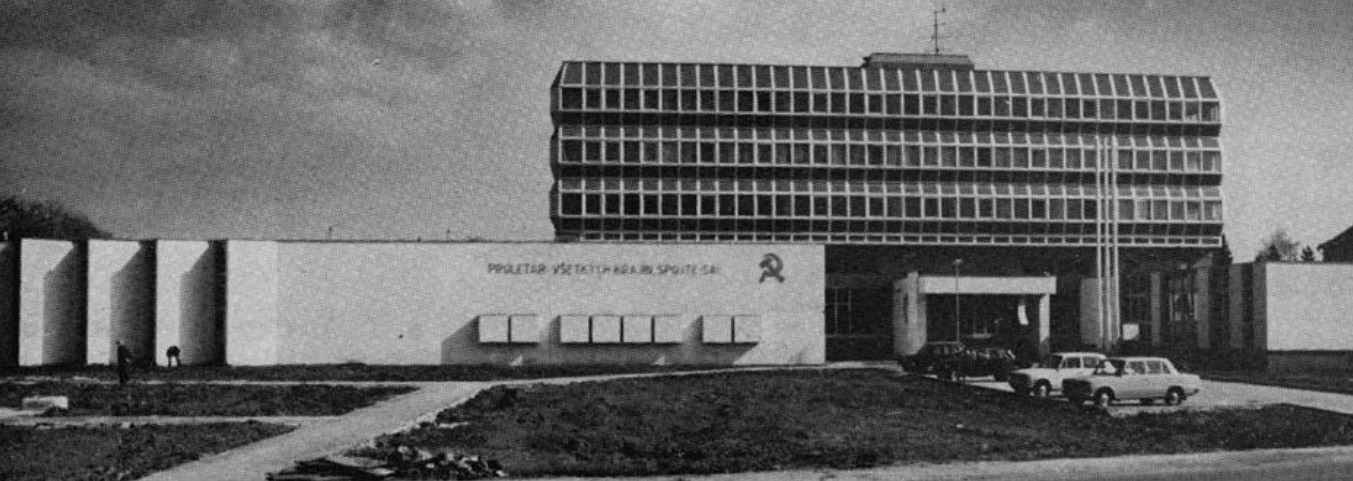
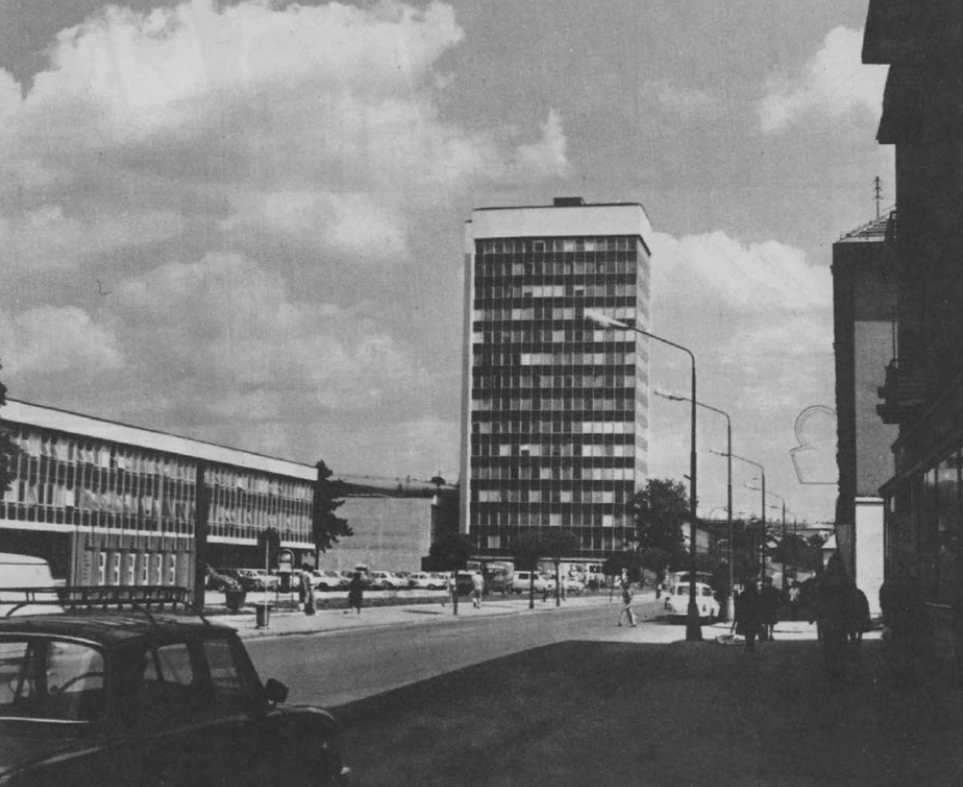
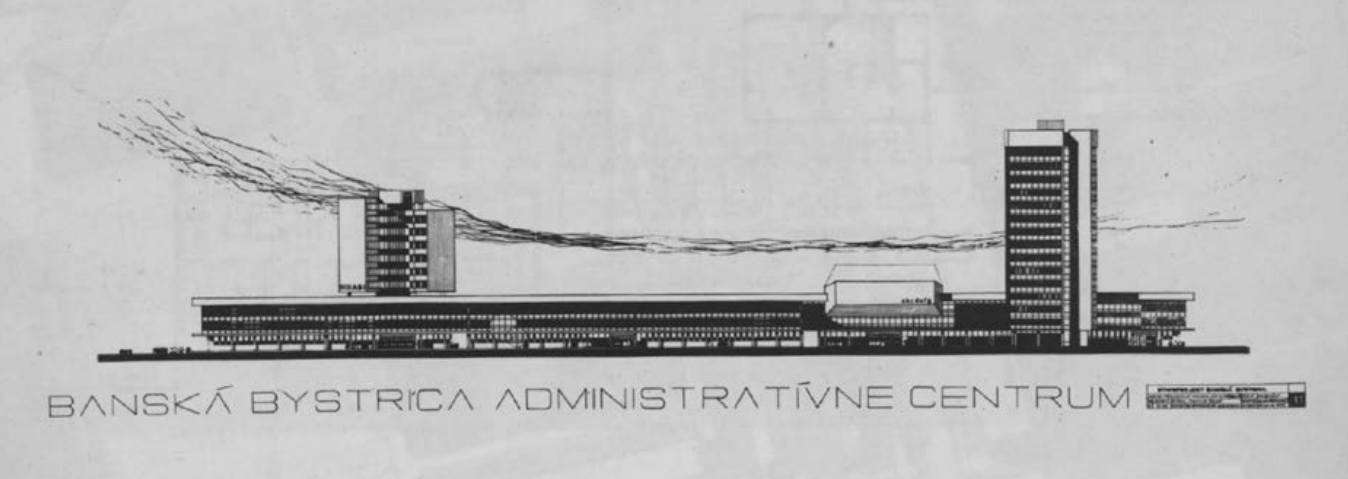
While the plan to combine the party and national committee bodies into a single high-rise complex remained unfulfilled in the east of the country, a more subtle version with greater emphasis on the urban character of the surroundings was partially realised in the region of Central Slovakia. At the end of the main street axis of Banská Bystrica, leading from the railway station near the block-style residential development of the station-fronting housing estate, a high-rise building was constructed to house both the Central Slovak Regional National Committee and the Regional Committee of the Communist Party of Slovakia. Known as the Regional Offices Building, it was designed by a team from Stavoprojekt Banská Bystrica led by architect Ján Hanzel,84 and became part of the new administrative and civic centre of the city. Although a lower-rising building with a classic reinforced concrete frame was originally intended, the ÚV KSS ultimately approved an increased budget to accommodate the architects’ requirements.85 By 1972, the 17-storey, steel-framed building with a lightweight curtain wall had been completed.86 According to the original plan, an additional three-storey office wing was to extend from the building towards the city centre, its verticality to be visually balanced by a high-rise office block on the opposite side of the base. However, the planned interconnection via part of the conference hall did not take place.
New Forms and Approaches in District Towns
The well-known “base-vertical” principle was not widely adopted in district towns, the sole exception being the OV KSS building in Trebišov (1976–1980) by architect Milan Motýľ. In this location, a six-storey administrative building with a closely attached base housing meeting rooms was erected. Unlike the previous light glazed facades, travertine cladding was the key material for unifying the exterior appearance. Another example of a compact design for administrative and meeting spaces is the ObV KSS Bratislava III (1974–1975).87 In this case, architect Rudolf Masný worked with a square floor plan, one corner of which housed the Presidium’s meeting room and extended slightly into the space, creating an interesting interior spatial concept based on a diagonal, whilst the architecture still gave a cohesive impression. The new secretariat building in Michalovce (1980–1983) by Ján Šprlák-Uličný can also be seen as a continuation of the approach of “mass compactness”. The massive block of the meeting hall, with only subtle openings, extended the corner wing of the administrative wing, thus fitting the building harmoniously into the street line of the elongated square.
However, an opposing architectural approach also emerged, based on the contrast between the administrative part of the secretariat and the meeting rooms or other supplementary spaces. This method is most notable in the building of the OV KSS in Levice (1981–1983), designed as an extension of the city park, linking up with the central urban zone. Two architects from the younger generation, Jozef Hrozenský and Štefan Sojka from Stavoprojekt Nitra, emphasised the contrast in form and material between the horizontal bases and the central administrative mass through using unconventional technical cladding.88 The atypical design, featuring vertically angled surfaces of a metallic cladding, was closely aligned with “machinism” or early hight-tech experiments of the Czechoslovak architectural scene of that period.
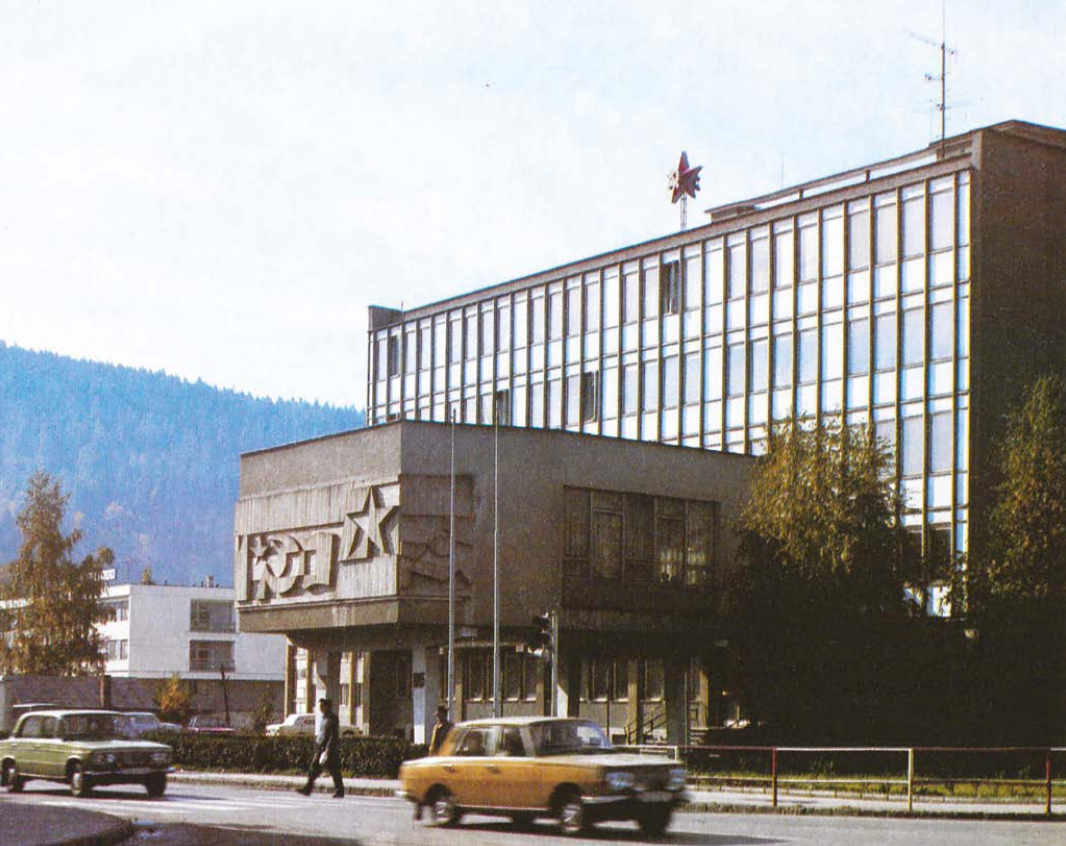
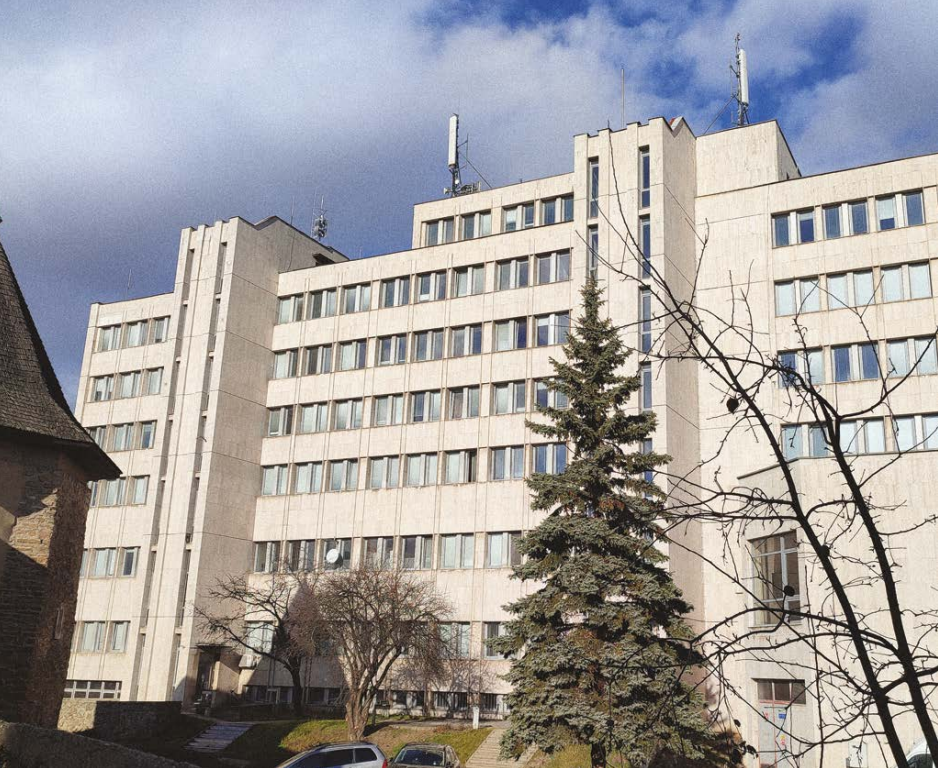
The OV KSS in Prievidza (1983–1986), designed by Rudolf Bizoň, also demonstrates an emphasis on greater fragmentation and differentiation of masses. The pair of halls, which have similar octagonal floor plans, are connected to the central administration block by a vestibule. Once again, the architect avoided the principle of a single unified mass and instead separated the two halls, a choice clearly reflected in the visual outline of the exterior forms. The clear structural layout of the meeting room complex, consisting of horizontal administrative blocks, was also applied to other buildings, including the OV KSS in Dolný Kubín (Ján Dzúr, 1970–1972), the OV KSS in Poprad (Ivan Balco, 1979–1981) and the OV KSS and House of Political Education extension in Galanta (Rudolf Blažo, 1979–1980). In contrast to the main part of the administrative block, which was structured simply by a window grid, the extension’s design was conceived in a freer manner. New elements were introduced, such as a distinctive staircase and curved overhanging walls, while the façade of the extension was unified by glass mosaic cladding.
Highlights of the Architects’ Work
The 1980s marked both the culmination and the end of the KSS secretariats’ building projects. As discussed above, the unrealised plan for the new political and administrative centre in Košice was not left without a replacement, while there remained the necessity of the party apparatus being concentrated in its own buildings.
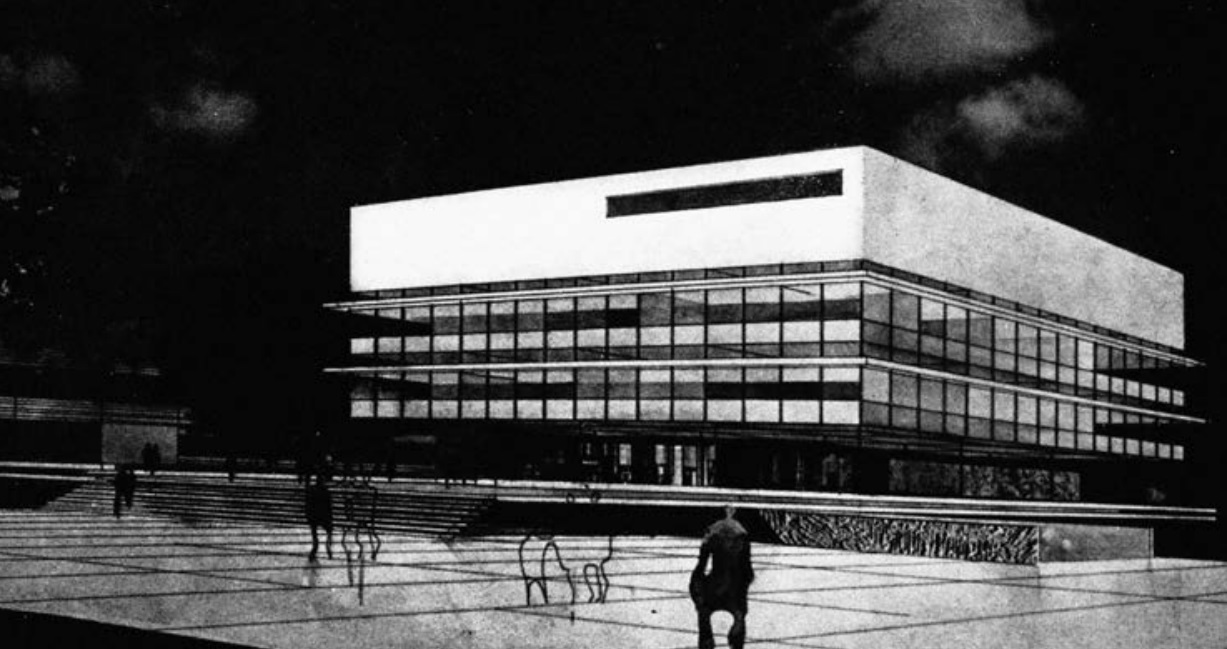
The ideal solution would have been a combined administrative building, offering organisational simplification and greater centralisation. Although the original plan to begin construction of the high-rise monoblock in 1975 failed, an initial project for the so-called “Operational Building of Party Bodies” was drawn up for a different location at that time. Based on a decision by the direct investor, the East Slovak Regional Committee of the KSS [Východslovenský krajský výbor KSS], the area of the New Town [Nové mesto] housing estate was chosen. Studio 1 of Stavoprojekt Košice, led by architect Milan Motýl, won the closed competition89 with a design featuring a graduated, horizontal composition of masses. Instead of the more universal form of a high-rise prism, which he had used before in Trebišov, in this case the architect opted for a gradually unfolding horizontality, responding appropriately to the site’s terraced profile. The result was a grouping of volumes in which the individual functional units of the district, municipal and regional committees, the meeting halls complex, and the House of Political Education with its attached bookshop were hierarchically separated. The entire building consisted of autonomous administrative wings using simple rectangular floor plans, a terraced area in the extensive entrance square, and a separate volume attached to one side of the building, housing a pair of conference halls. Visually, the administrative sections were distinguished from the hall sections by their external cladding: a glazed façade with aluminium frames and cantilevered parapet bands clad in white aluminium. By contrast, the conference complex was conceived as a separate structure with an irregular floor plan and was clad entirely in travertine, except for narrow vertical windows.
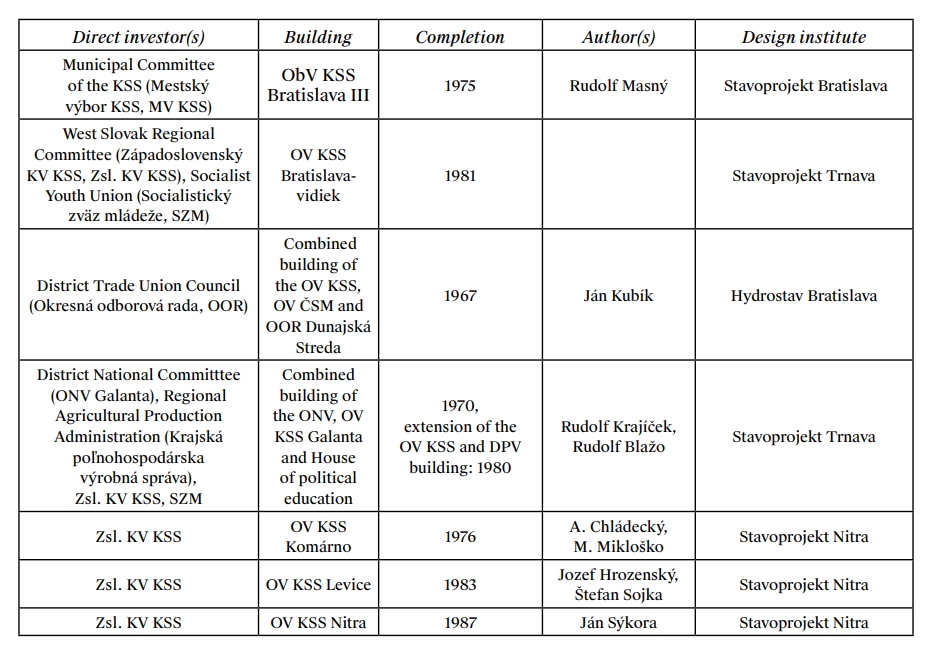
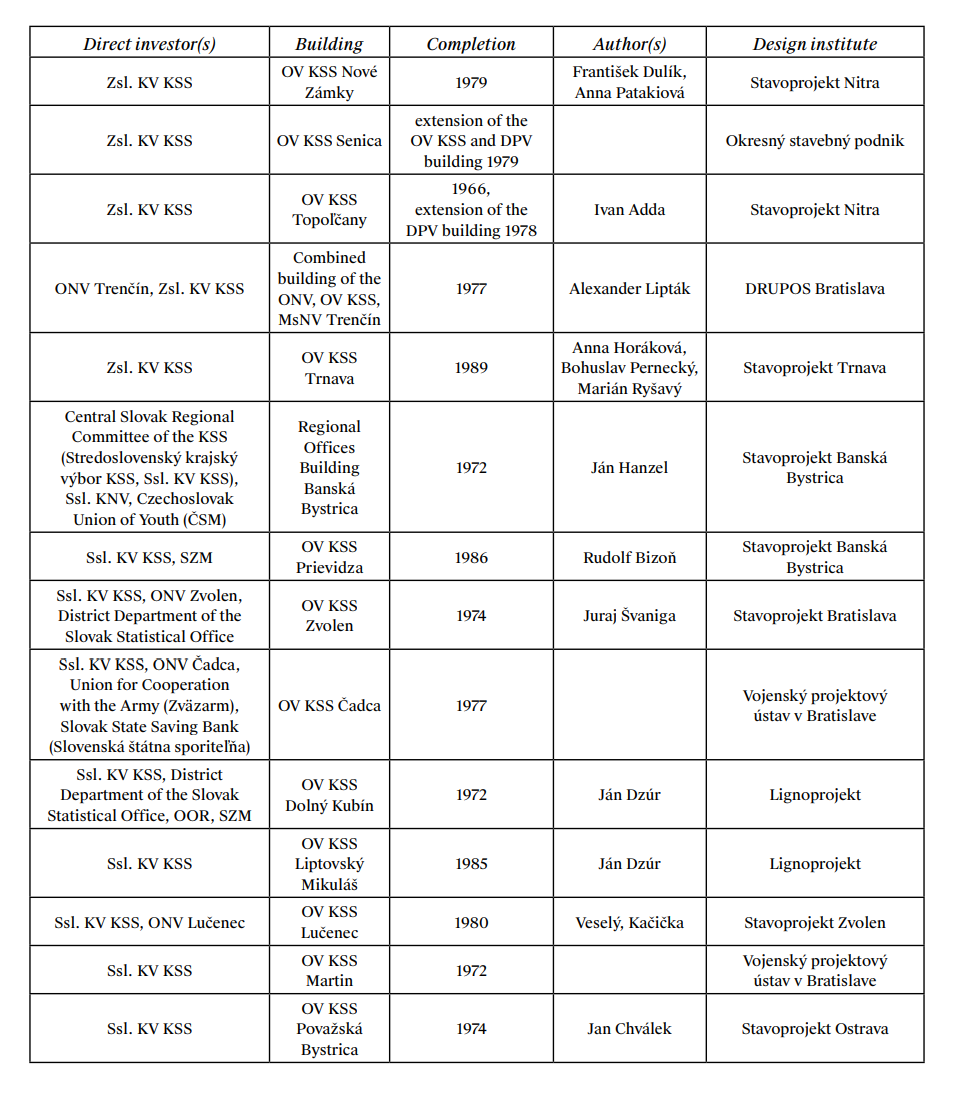
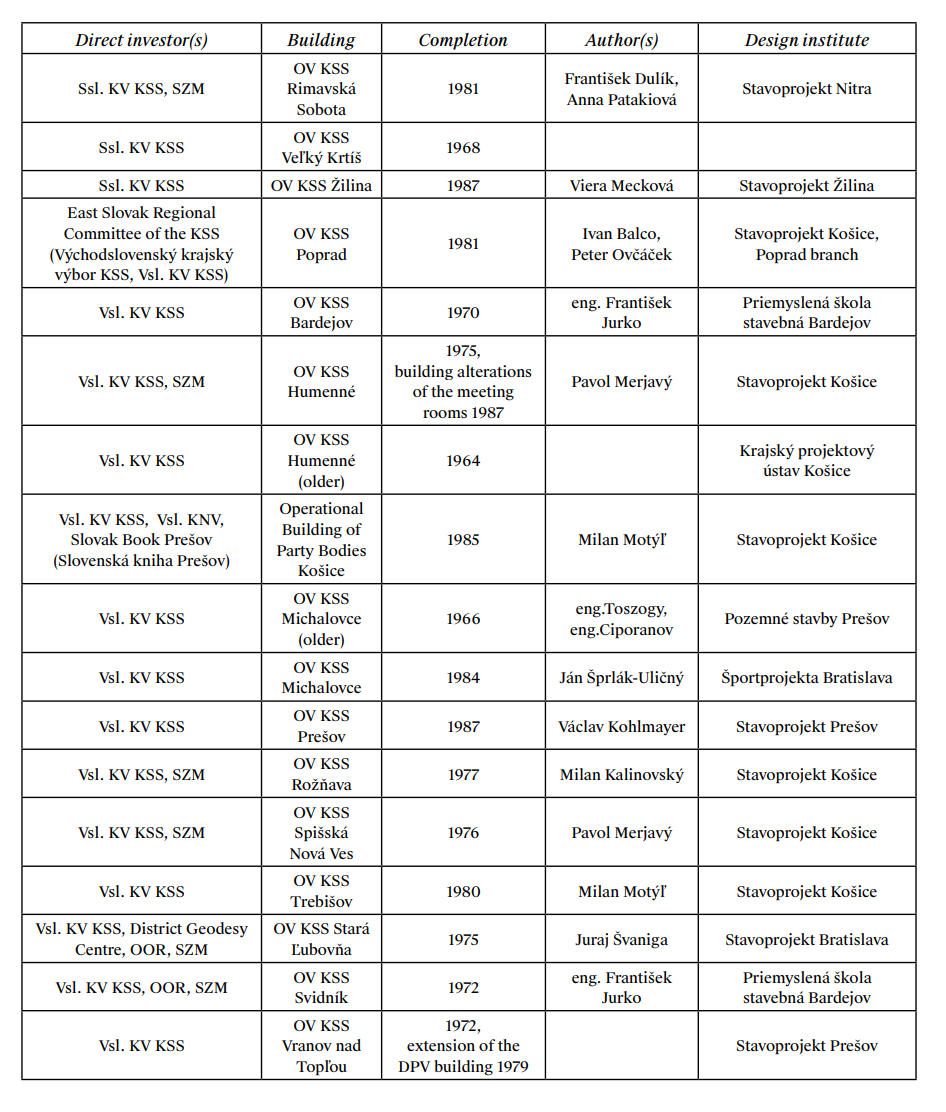
Connecting an autonomously designed meeting hall to the administrative section via a corridor or foyer was a scheme that had already been used in smaller projects for district secretariats. As the scale increased, this model became widely adopted for the functional separation of office and social spaces. A complex containing a small hall, a large hall or a single large meeting room could be formally separated from the rest of the building. Conversely, however, the spatial separation could be visually offset by a unifying façade. Thus, the administrative block of the OV KSS in Prešov (Václav Kohlmayer,1983–1987) remained firmly linked to the rest of the building through its travertine cladding, despite the mass of the meeting rooms standing out at the edge of the square. Viera Mecková’s intention to visually link all functional parts into a cohesive entity was realised in the form of a curtain wall of smooth ceramic cladding at the OV KSS in Žilina (1984–1987). The large side meeting room, which has an octagonal floor plan, and the staircases serving the two administrative blocks were clad in the same material and further complemented by atypical elements featuring inlaid patterns.90 The building was unified by both the cladding material and the artistic programme developed on the façade itself.
As with many previous examples, the OV KSS building in Nitra (1984–1987) was situated in a prominent new central urban area.91 However, it applied a different principle of mass composition. Architect Ján Sýkora designed the administrative section of the secretariat as a cantilevered extension above the groundfloor base. Rather than being attached to this central mass in the traditional way from the side, the meeting room was connected to the main administrative section along the entrance axis, thus forming the entire building as a single distinctive symmetrical volume. Further reinforcing this visual unity was the façade design, featuring vertical divisions and a uniform colour scheme. In response to the low-rise historic buildings in the immediate neighbouring area of the OV KSS in Trnava (completed in 1989), the volumes were developed in width along the street line. The design team, consisting of Anna Horáková, Bohuslav Pernecký and Marián Ryšavý, worked with intersecting horizontal wings, which featured prominent main entrances and roof parapets. Once again, a unified cladding was employed, this time in the form of light-coloured ceramic tiles.
The works from this peak phase served as the dominant architectural structures in their relevant urban areas. Compared to earlier projects, they stood out due to their size: the increased number of offices and classrooms, as well as the greater capacity of meeting rooms, had to be reflected in the building’s volumes. As in other architectural typologies, lightweight glazed curtain walls were replaced by materials that further emphasised the weight of the structures. In addition, the widespread requirement for standardisation of elements such as window and door frames, and particularly of structural systems, affected the KSS secretariats, necessitating that design possibilities remained limited with little experimentation. The standard was a prefabricated reinforced concrete structure for administrative blocks, with larger meeting room spans made possible by using steel truss ceiling structures. Increased costs and the architects’ creative approaches were more evident in the building envelope’s materiality, spatial concepts of communal areas, and interior design. Entrance halls, foyers, and other spaces of social significance, such as leading secretaries’ meeting rooms in the administrative section of the buildings or the main conference halls, featured richer design forms and materials. The architects’ solutions involved diverse compositions of acoustic ceilings, decorative wall cladding, lighting, and even custom-produced furniture.
In the context of the architects’ careers, the KSS secretariats of the 1980s represented their greatest achievements – in sharp contrast with the general atmosphere in design practices at that time, which produced projects aimed more at quantity than quality. Subordination to the work of the design organisation often meant setting personal creative ambitions aside.92 Commissions for party headquarters were one of the building types that allowed greater creative expression. For the architects, these commissions thus became lucrative architectural assignments.
Conclusion
Investment plans prepared by the party authorities reflected the need to modernise the building stock. The secretariats of the municipal, district and regional committees of the Communist Party of Slovakia were responsible for implementing the directives of the Communist Party of Czechoslovakia and further developing resolutions to meet the specific needs of Slovakia.
The period of normalisation brought about a reconstruction of the social and power base through the recruitment of new members and political cadres, which in turn created a demand for workplaces, training facilities and social spaces. In turn, the education of these new Party members, their political and organisational work, and their propaganda activities became important in shaping the party’s political power, which was maintained from within by the Party apparatus. And, it should be stressed, this apparatus had a dual nature. On the one hand, it comprised the Party’s numerous staff, and on the other, it operated as a network of institutions of the secretariats spread across the country, with its consolidation and expansion forming a pillar of the communist regime. For this reason, I believe that this architecture can be considered political, even outside the category of representation.
After 1989, the Communist Party lost power, and the system of five-year economic plans came to an end with the 8th five-year plan (1986–1990). The ideas presented by Ján Šváb, the Communist official responsible for the KSS’s investment construction, were never fully realised. Nevertheless, an extensive network of a specific type of administrative building was established across Slovakia.
However, the picture of this building type is still incomplete. The question of the urban placement of these buildings is important in the context of creating new urban zones within the city’s structure. A closer look inside the party secretariats, which would reveal the spatial concepts and interior fittings, or how daily life unfolded within them, could provide further insights into the function and workings of the party apparatus. Nor should the necessarily marginal references in the present study diminish the importance of the buildings’ artwork, which was an integral part of many projects. Here, the question of representation plays a more significant role. After all, the abstract form of architecture conveys the tenets of official state Marxist-Leninist ideology less efficiently than scenes from workers’ life or a larger-than-life statue of Lenin at the entrance to the party building. However, alongside the statues of communist leaders in public spaces and the busts of leading secretaries in meeting halls, artworks without explicit political emphasis were also featured.
This little-known and overlooked architectural type, ranging from products of the construction industry to the architectural landmarks of Slovak cities, thus has the potential to provide an even deeper understanding of the moments where politics and architecture intersect.
This paper was supported by the VEGA agency (Grant no. 1/0063/24), the APVV agency (Grant no. 23-0101) and the Doktogrant (Grant no. APP0818).
Mgr. Monika Kicová
PhD. Candidate
orcid: 0009-0003-2934-3779
Department of Architecture
Institute of History, Slovak Academy of Sciences Klemensova 19
811 09 Bratislava Slovakia
Slovakia
monika.kicova@savba.sk
GJURIČOVÁ, Adéla and ZAHRADNÍČEK, Tomáš. 2021. Skrytá prostorovost českoslov-enské federace. Role národních rad v transformacích 1989–1992. Soudobé dějiny, 28(1), p. 26. doi: 10.51134/sod.2021.018
The term normalisation originates from the regime’s vocabulary of the time. Communist leaders used it to refer to the stabilisation, or “con-solidation” of the regime following the suppression of reformist forces and the seizure of power in April 1969. In historiography, it denotes a process involving the suppression of reformist efforts towards democratisation and a return to the Soviet model of socialism. In terms of its reference
to a specific period, the term is most aptly applied to the turn of the 1960s and 1970s, when the regime stabilised. However, it is also commonly used to denote the entire period from 1969 to 1989. I also use it in this sense in the fol-lowing text. For the various meanings and characteristics of normalisation see MERVART, Jan. 2017. Rozdílnost pohledu na československou normalizaci. In: Činátl, K., Mervart, J. and Najbert, J. (eds.). Podoby československé normalizace: dějiny v diskuzi. Prague: Institute for the Study of Totalitarian Regimes, pp. 40–78.
KOCIAN, Jiří et al. (eds.). 2020. Dějiny Komunistické strany Československa IV (1969–1993). Prague: Academia, p. 18.
HUDEK, Adam. 2022. An Uncommon Course: Normalisation in Slovakia. In: McDermott, K. and Stibbe, M. (eds.). Czechoslovakia and Eastern Europe in the Era of Normalisation, 1969–1989. Cham: Springer International Publishing, p. 98. doi: 10.1007/978-3-030-98271-3_5
SIKORA, Stanislav. 2016. Politický vývoj na Slovensku 1968–1971. In: Londák, M., Sikora, S. and Londáková, E. (eds.). Od predjaria k normalizácií: Slovensko v Československu na rozhraní 60. a 70. rokov 20. storočia. Bratislava: Veda, p. 120.
MARUŠIAK, Juraj. 2008. The Normalisation Regime and its Impact on Slovak Domestic Policy after 1970. Europe-Asia Studies, 60(10), p. 1810. doi: 10.1080/09668130802434695
f. (Fund) Sekretariát ÚV KSS, 1945–1990, and f. Predsedníctvo ÚV KSS, 1945–1990, Slovak National Archive (hereinafter SNA). The minutes of the Secretariat and Presidium meetings were examined. During these meetings, the secretaries of the Economic Department presented reports and proposals for investment projects for approval and shared updates on economic management.
f. ÚV KSČ 1945–1989, Praha – sekretariát 1966–1971 and f. ÚV KSČ 1945–1989, Praha – předsednictvo 1971–1976, National Archive of the Czech Republic (hereinafter NA).
⦁ TÓTHOVÁ, Lucia M. and ULLMANNOVÁ, Klára. 2025. The Ambition for Centralized Control: An Organizational History of the Czechoslovak State Design Institute Stavoprojekt Between 1948 and 1953. Architektúra & urbanizmus, 59(1–2), pp. 142–155. doi: 10.31577/archandurb.2025.59.1-2.8; MLYNČEKOVÁ, Lucia. 2022. Project Institutes in Czechoslovakia in the 1970s Creation in the Conditions of a Centrally Planned Economy during the Normalisation Period in Czechoslovakia. Architektúra & urbanizmus, 56(1–2), pp. 106–115. doi: 10.31577/archandurb.2022.56.1-2.9
The emphasis on the role of the client in creating an artwork can be traced back to the writings of the 19th-century cultural historian Jacob Burckhardt. The contemporary approach of the social history of art, enriched by an analysis of socio-eco-nomic conditions represents Michael Baxandall’s methodological turn. See KROUPA, Jiří. 2010. Gombrichův návrat k Jacobu Burckhardtovi. In: Mikš, F. and Kesner, L. (eds.). Gombrich:porozumětuměníajehodějinám. Brno: Barrister&Principal, pp. 15–34; BAXANDALL, Michael. 1972. Painting and Experience in Fifteenth-Century Italy. Oxford: Oxford University Press.
KAROUS, Pavel (ed.). 2019. Hotel Praha. Prague: BiggBoss; KOUK-ALOVÁ, Šárka. 2018. Rekreační středisko “Orlík” ve Vystrkově pro představitele vlády a ÚV KSČ. Zprávy památkové péče, 78(6), pp. 680–684; KOUKALOVÁ, Šárka. 2019. Jinak lidu, jinak vladcum. Paměť a dějiny, 13(4), pp. 26–34; MITÁŠOVÁ, Monika
(ed.). 2018. Vladimír Dedeček: interpretations of his architecture: the work of a post war Slovak architect. Basel: Birkhäuser, pp. 55–63.
PAVEL, Miroslav. 2022. Veřejně tajné, prominentně obyčejné a nenávistně zapomenuté. Budovy ústředí KSČ. Dějiny a současnost, 44(1), pp. 15–17; PAVEL, Miroslav. 2020. Bohumil Böhm a jeho nadstranícká architektura stranických výborů KSČ jižních Čech. Beton v architektuie, 119(5), pp. 56–61; PAVEL, Miroslav. 2019. Odkud vládla strana. In: Vorlík, P. (ed.). (A)typ: architektura osmdesátých let. Prague: Czech Technical University in Prague, Faculty of Architecture, pp. 88–94.
Pavel, M., 2019, p. 88.
PAVEL, Miroslav. 2020. Naděžda a Antonín Dvořákovi – Žádný chrám, bude to úplně normální administrativní budova. In: Vorlík, P. (ed.). Rozhovory/Architektura osmdesátých let. Prague: Czech Tech-nical University in Prague, p. 105.
Pavel, M., 2022, p. 17.
MECKOVÁ, Viera and STUCHL, Antonín (eds.). 2003. Architektúra, knižná väzba, šperk. Cena Emila Belluša 2003 [exhibition catalogue]. Žilina: Slovak Architects Society.
DRAHOVSKÝ, Martin. 1995. Architekt Ján Šprlák-Uličný. Martin: Neografia.
In the pioneering book on modern architecture in Slovakia by Henrieta Moravčíková and Matúš Dulla, the buildings of the district committees of the Communist Party of Slovakia in the cities of Trenčín, Žilina and Prešov are only mentioned in the final list of the most significant architectural works. The Žilina building is the only one to receive greater attention, being included in Matúš Dulla’s catalogue overview of new Slovak architecture. See DULLA, Matúš and MORAVČÍKOVÁ, Henrieta. 2002. Architektúra Slovenska v 20. storočí. Bratislava: Slovart; DULLA, Matúš (ed.). 1991. Nová slovenská architektúra. Bratislava: Slovak Architects Society, pp. 50–51.
ZALČÍK, Tibor and DULLA, Matúš. 1982. Slovenská architektúra 1976–1980. Bratislava: Veda, p. 58.
KICOVÁ, Monika. 2024. Continuity and Transformation of Post-War Modernist Architecture: The Case Study of the Former Communist Party Headquarters in Košice, Slovakia. In: Torrent, H. (ed.). Modern Futures. Sustainable Development and Cultural Diversity: 18th International DOCOMOMO Conference, pp. 806–811; MAGDOLENOVÁ, Jana. 2024. Revitalizácia budovy bývalého OV KSS, Prievidza. Master’s thesis. Slovak University of Technology in Bratislava, Faculty of Architecture and Design.
MOLNÁR, Virág Eszter. 2013. Building the state: architecture, politics, and state formation in post-war central Europe. London: Routledge, Taylor & Francis Group, pp. 11–12.
Molnár draws on the socio-logical concept of “logistical power”, which focuses, in contrast to an accent on force and coercive means, on the effective organisation of the material world and infrastruc-ture to enable the management of social processes. The starting point for this perspective is a Marxist understanding of social organisation, with its basis in material conditions. See MUKERJI, Chandra. 2010. The Territorial State as a Figured World of Power: Strategics, Logistics, and Impersonal Rule. Sociological Theory, 28(4), pp. 402–424. doi: 10.1111/j.1467-9558.2010.01381.x
However, these questions were only recorded as barely legible handwritten notes from meetings of the Secretariat or the Presidium of the Central Committee of the KSS, at which proposals for approving the construction were discussed.
PEŠEK, Jan. 2010. Komunistická strana Slovenska v rokoch 1945–1948. In: Kocian, J., Pažout, J., and Rákosník, J. (eds.). Bolševismus, komunismus a radikální socialismus v Československu. Prague: Institute of Contemporary History, pp. 165–184.
Although Constitutional Act No. 143/1968 on the Czechoslovak Federation brought about changes to the structure of the state and its institutions, the political system was not federalised due to pressure from Moscow. There was no parallel organisation for Bohemia and Moravia. The Communists in the Czech part of the federation were directed by a special office, the so-called “Byro ÚV KSČ pro iízení stranické práce v českých zemích”. ŽATKULIAK, Jozef. 1996. Federalizácia Československého štátu 1968–1970: Vznik československej federácie roku 1968. Prague/Brno: Institute of Contemporary History, Czech Academy of Sciences, p. 418.
ŠOLC, Miroslav and FOL-PRECHT, Vladimír. 1984. Organizační výstavba stranických orgánů a organizací a jejich základní úkoly. Prague: Svoboda, pp. 32–49.
PEŠEK, Jan. 2016. Členstvo, organizácia a vedenie Komunistickej strany Slovenska v rokoch 1948 – 1968. In: Roguľová, J. and Hertel, M. (eds.). Adepti moci a úspechu. Etablovanie elít v moderných dejinách. Bratislava: Veda, pp. 441–442.
PEŠEK, Jan. 2006. Centrum moci: aparát Ústredného výboru Komunistickej strany Slovenska 1948 – 1989. Bratislava: AEPress, p. 21.
KAPLAN, Karel. 1993. Aparát ÚV KSČ v letech 1948-1968: studie a dokumenty. Prague: Institute of Contemporary History, Czech Academy of Sciences, p. 7.
Pešek, J., 2006, p. 22.
Pešek, J., 2006, pp. 25–26.
PEŠEK, Jan. 2005. Komunistická strana Slovenska – územná organizácia Komunistickej strany Československa na Slovensku. In: Kárník, Z. and Kopeček, M. (eds.). Bolševizmus, komunismus a radikální socialismus v Československu. Svazek IV. Prague: Dokořán, pp. 125–126.
ÚV KSS (164), KV KSS (259), OV KSS (1290). Pešek, J., 2005, p. 126.
ÚV KSS (172), KV KSS (274), OV KSS (1354). Pešek, J., 2005, p. 126.
MARUŠIAK, Juraj. 2003. Slovenská spoločnosť za normalizácie. In: Česká a slovenská společnost v období normalizace = Slovenská a česká spoločnosť v čase normalizácie: Liberecký seminár 2001. Bratislava: Veda, pp. 130–131.
Marušiak, J., 2003, p. 138.
Marušiak, J., 2003, p. 138.
PAŽOUT, Jaroslav and VILÍMEK, Tomáš. 2020. Komunistická strana Československa v období tzv. normalizace (1969–1989). In: Kocian, J. et al. (eds.). DějinyKomunistické strany Československa IV (1969–1993). Prague: Academia, p. 37.
In Slovakia, 17.6% of members faced membership cancellations and expulsions from the KSS. In the Czech part of the country, the repression was more severe, with the Party purging approximately 21.7% of its members. SIKORA, Stanislav. Politický vývoj na Slovensku 1968–1971, p. 120; MAŇÁK, Jiří. 1997. Čistky v Komunistické straně Československa 1969–1970. Prague: Institute of Contemporary History, Czech Academy of Sciences,
KMEŤ, Norbert. 2010. Komunistická strana Slovenska 1969–1985. In: Bolševizmus, komunismus a radikální socialismus v Československu. Svazek VII. Prague: Dokořán, p. 241.
Kmeť, N., 2010, p. 245.
KUDLÁČOVÁ, Blanka. 2024. Preparation of the Future Elites of the Communist Party in the Period of Communism in Slovakia. Historia scholastica, 10(2), pp. 186–187. doi: 10.15240/tul/006/2024-2-008
Budování “Domů politické výchovy” a “Kabinetů politické výchovy”, 1971 f. ÚV KSČ 1945–1989, Praha – sekretariát 1966–1971, č. pom. (ref. number) 1594 a. j. (archival unit) 121 (file)/b. 4, sv. (volume) 69. NA.
Kmeť mentions existing DPVs in Bratislava, Košice and Nitra. The concept for developing the DPV network also includes Banská Bystrica. Kmeť, N., 2010, p. 251. Compare with Budování “Domů politické výchovy” a “Kabinetů politické výchovy”, p. 6.
Budování “Domů politické výchovy” a “Kabinetů politické výchovy”, p. 7.
SLABEY, Ladislav and ŠVÁB, Ján. 1984. Povinnosti voči strane. Nové Slovo, 26(39), p. 13.
Guidelines for the Preparation of Investment Plans [Pokyny pre vypracovanie investičných zámerov], 1972, ÚV KSS. Documents of the Prešov District Office. Unprocessed.
The role of head designer was often taken on by the state design institute Stavoprojekt that operated in the same region as the relevant party body, which was the direct investor. However, there were also exceptions. For instance, Stavoprojekt Bratislava was responsible for the design of the OV KSS building in Stará Ľubovňa, despite it falling under the investment responsibility of the Eastern Slovak Regional Committee of the KSS. The building of the OVKSS in Považská Bystrica was even designed by the Czech institute Stavoprojekt Ostrava.
The system of so-called democratic socialism was applied in the exercise of power. Resolutions of higher bodies were automatically binding on lower ones. Although the regime demanded activity from party members and presented internal party discussion and criticism as democratic, the primary requirement was to observe party discipline and only speak on defined topics. Otherwise, officials faced sanctions and party punishments. Pažout, J. and Vilímek, T., 2020, p. 37.
This is also confirmed by the architects themselves, who, once they had made contact with the central investor – the Party’s economic department – it was more often in Prague than in Bratislava. Based on interviews with architects: Milan Motýľ, Václav Kohlmayer and Rudolf Bizoň.
Správa o plnení úloh investičného plánu Komunistickej strany Slovenska a PRAVDY, tlačového kombinátu KSS za rok 1973. f. Sekretariát ÚV KSS, Zasadnutia sekretariátu 30. 4. 1974, 1474/8, a. j. 69, p. 17, box 409. SNA.
Správa o plnení úloh in-vestičného plánu Komunistickej strany Slovenska a PRAVDY, tlačového kombinátu KSS za rok 1973. f. Sekretariát ÚV KSS, Zasadnutia sekretariátu 30. 4. 1974, 1474/8, a. j. 69, p. 17, box 409, p. 18. SNA.
KRÁLÍK, František and POHANKOVÁ, Jana. 1990. Majetek KSČ? Koordinační centrum OF, ČKD Polovodiče. pp. 9 –10.
Úprava majetkoprávních vztahů u budov ve vlastnictví státu používaných KSČ, 1971 f. ÚV KSČ 1945-1989, Praha – předsednictvo 1971–1976, č. pom. 1590, a. j. 8/19, sv. 9, p. 6–11. NA.
Úprava majetkoprávních vztahů u budov ve vlastnictví státu používaných KSČ, 1971, p. 11.
The fact that these were as-sets of the Czechoslovak state took on significance after the fall of the communist regime. National com-mittees were thus able to allocate former party buildings to other users without having to resolve property rights issues. Constitutional Act No. 496/1990 on the Return of the Property of the Communist Party to the People of the Czech and Slovak Federal Republic thus applied to only six of the many administrative buildings of the KSS secretariats in Slovakia, that were officially owned by the party. See Národná Obroda. 1992. Malá inventúra o odovzdávaní majetku KSS: Príliš komplikovaný proces. Národná Obroda, 3(127), p. 2.
Návrh finančného rozpočtu Komunistickej strany Slovenska na rok 1965, f. tajomník Ján Janík, Predsedníctvo ÚV KSS, Zasadnutie predsedníctva ÚV KSS 21.12. 1964, 382/16, a. j. 65, p. 2, 3. box 1140. SNA.
The budget item “Investments and Major Repairs” included a sum representing a 126% increase compared to 1964, and a 170% increase compared to 1963. Construction investments accounted for the largest share of this; Návrh finančného rozpočtu Komunistickej strany Slovenska na rok 1965, f. tajomník Ján Janík, Predsedníctvo ÚV KSS, Zasadnutie predsedníctva ÚV KSS 21.12. 1964, 382/16, a.j. 65, p. 9, 14. box 1140. SNA.
Note in this regard Miroslav Pavel’s study in this issue.
Pešek, J., 2005, p. 123.
Návrh na presťahovanie Obvodného výboru KSS Bratislava IV., f. Sekretariát ÚV KSS, Zasadnutia sekretariátu ÚV KSS 13. 6. 1973, 1019/8, a. j. 48, p. 1–5, box 386. SNA.
KUSÝ, Martin. 1973. Vývoj administratívnych budov na Slovensku. Projekt, 15(2), p. 7.
A typical feature was the use of 19th century buildings; for example, the OV KSS in Dolný Kubín had its headquarters in the former County Hall. Návrh na schválenie projektových úloh na výstavbu združených administratívnych budov OV KSS, f. Sekretariát ÚV KSS, Zasadnutie sekretariátu ÚV KSS, 30. 6. 1970,
846/12, a. j. 45, 9. 4, box 318. SNA.
Návrh na schválenie Projektovej úlohy stavby: “Adminis-tratívna budova OV KSS SPIŠSKÁ NOVÁ VES”, f. Sekretariát ÚV KSS, Zasadnutia sekretariátu 13. 6. 1973, 995/8, a. j. 48, p. 6, box 386. SNA.
Návrh na schválenie investičných úloh pre výstavbu administratívnych budov Ssl. KV KSS, OV KSS Liptovský Mikuláš a OV KSS Galanta, f. Sekretariát ÚV KSS, Zasadnutia sekretariátu 11. 6. 1965, 126/6, box 265. SNA.
For example, in Trnava, the party initially used the building of the District Institute of National Health, and it was only later that the apparatus was moved to the new ONV building. Návrh na presťahovanie Okresného výboru KSS v Trnave do novopostavenej budovy ONV na ceste SNP, f. Sekretariát ÚV KSS, Zasadnutia sekretariátu 24. 7. 1966, 157/10, a. j. 11, p. 3, box 275. SNA.
The party headquarters were relocated in line with the new territorial structure of 1960, which established new party bodies in Slovakia. Based on a survey, the Economic Department of the ÚV KSS reported that “Of the 33 newly established district committees, it is only possible in four cases to house these party bodies in existing buildings without alterations. In 12 cases, it is necessary to adapt existing buildings. (…) For a further 17 district committees, existing buildings are unsuitable, and alterations would not resolve the issues. It is therefore essential to relocate these committees.” Zpráva [sic!] o situácii a návrh na umiestnenie novovytvorených orgánov a inštitúcií KSČ na Slovensku v súvislosti s novou územnou organizáciou. f. Sekretariát ÚV KSS, Zasadnutie sekretariátu ÚV KSS, 11. 3. 1960, 104/7, a. j. 12, p. 6, box 202. SNA.
Work on the joint building for the ONV and the OV KSS in Martin began in 1962. However, after the building’s foundations had been laid, the project’s direct investor, the Central Slovak KV KSS, suspended construction due to a government resolution that restricted investment projects. Návrh na schválenie výstavby administratívnej budovy pre OV KSS v Martine. f. Sekretariát ÚV KSS, Zasadnutie sekretariátu 1969, 279/11, a. j. 12, p. 3, box 299. SNA.
Správa o hospodárení Komunistickej strany Slovenska za rok 1964, f. tajomník Ján Janík, Predsedníctvo ÚV KSS, Zasadnutia predsedníctva ÚV KSS, 27. 3. 1965, 91/14, a. j. 72, p. 26, box 1140. SNA.
Administratívna budova OV (in-vestičná úloha + projekt dvojpodlažná budova), f. Mestský národný výbor v Humennom, 1944 – 1991, inv. no. (inventory number) 50 – 1964 – 10. State Archive in Prešov, Humenné branch.
The technical report on the de-sign of the OV KSS building in Michalovce states that it was a revised version of the original administrative building of the district court in the city of Bardejov. Jednostupný [sic!] projekt. Administratívna budova OV KSS – Michalovce, f. MsNV Michalovce. Odb. výstavby. sig. 1230. State Archive in Košice (hereinafter ŠAK), Michalovce branch.
DÚBRAVICKÝ, Jozef. 1985. Ivan Adda. Projekt, 27(2), p. 43.
Výtvarný život. 1969. Z tvorby Karola Paluša. Výtvarný život, 14(7), p. 44.
TALAŠ, Stanislav. 1968. Ústav ekonomiky a organizácie stavebníctva. Výtvarný život, 13(5), pp. 224–225.
Územné rozhodnutie – Administratívna budova OV KSS v Humennom, 24. 1. 1977, Okresný národný výbor, odbor výstavby. Documents of the Humenné Municipal Office. Unprocessed. Humenné Municipal Office.
KARFÍK, Vladimír. 1980. Nová výstavba v centre Bratislavy. Architektura ČSR, 39(6), pp. 242–245.
Dôvodná správa k výstavbe politicko-administratívneho a správneho centra v Košiciach
p. 2, f. Vsl. KNV v Košiciach II. 1971–1990 (1991), Sekretariát I. Podpredsedu, inv. no. 25, box 4. ŠAK.
This was linked to the abolition and re-establishment of regional national committees.
f. Vsl. KNV v Košiciach II. 1971–1990 (1991), p. 5, inv. no. 25, box 4. ŠAK.
f. Vsl. KNV v Košiciach II. 1971–1990 (1991), p. 5, inv. no. 25, box 4. ŠAK.
During normalisation, the official politics of memory refocused attention on aspects of remembrance associated with the revolutionary “progressive traditions” of the Communist movement, such as anti-fascist resistance and Soviet liberation, intended to suppress the memory of the Prague Spring and the Soviet occupation of August 1968. In urban spaces, this manifested as efforts to refurbish existing monuments and statues of leading communist figures, as well as the building of new ones. See DEVÁTÁ, Markéta. 2024. Pomníková politika: národní výbory a zacházení s veřejným prostorem za normalizace. In: Gjuričová, A., Nodl, M. and Pospíšil, S. (eds.). Město jako laboratoi změny: mezioborové výzvy. Prague: Argo, pp. 184–185.
Administratívno-správne centrum Košice, PÚ a štúdia – vy-jadrenie, p. 5, f. Vsl. KNV v Košiciach II. 1971–1990 (1991), Sekretariát I. Podpredsedu, inv. no. 25, box 4. ŠAK.
Uznesenie Rady Vsl. KNV z 24. 10. 1972. f. Vsl. KNV v Košiciach II. 1971–1990 (1991), Sekretariát I. Pod-predsedu, inv. no. 25, box 4. ŠAK.
BENČAT, Ondrej. 1978. Príspevok Stavoprojektu Banská Bystrica k rozvoju krajského sídla Banská Bystrica. Urbanita, 6(1), pp. 90–99.
Návrh na zmenu investičného objemu na výstavbu administratívnej budovy pre stranícke orgány
a orgány ČSM v Banskej Bystrici, f. Sekretariát ÚV KSS, Zasadnutia sekretariátu ÚV KSS, 17. 2. 1968,
40/10, a. j. 2, p. 4, box 292. SNA.
KARFÍK, Vladimír. 1973. Naše prvé výškové budovy. Pro-jekt, 15(1), p. 20.
ŠLACHTA, Štefan. 1977. Budova sekretariátu ObV KSS Bratislava III. Architektura ČSR, 36(6), pp. 263–265.
DUBRAVICKÝ, Jozef and HROZENSKÝ, Jozef. 1987. Budova OV KSS v Leviciach. Projekt, 29(8), pp. 36–37.
Based on an interview with Milan Motýľ.
MECKOVÁ, Viera. 1990. Nový návrat keramického obkladu. Projekt, 32(2), pp. 17–19.
BORGUĽA, Michal and SÝKORA, Ján. 1991. (Bývalá) organizačná budova OV KSS v Nitre. Projekt, 33(3), p. 20.
ZIKMUND, Jan. 2019. Možnosti adaptace. In: Dvořáková, D., Guzik, H. and Zikmund, J. (eds.). Architektura v pierodu: 1945–1948, 1989–1992. Prague: Czech Technical University in Prague, Faculty of Architecture,
pp. 207–208.
DOI: https://doi.org/10.31577/archandurb.2026.60.1-2.6

This work is licensed under a Creative Commons Attribution 4.0 International License