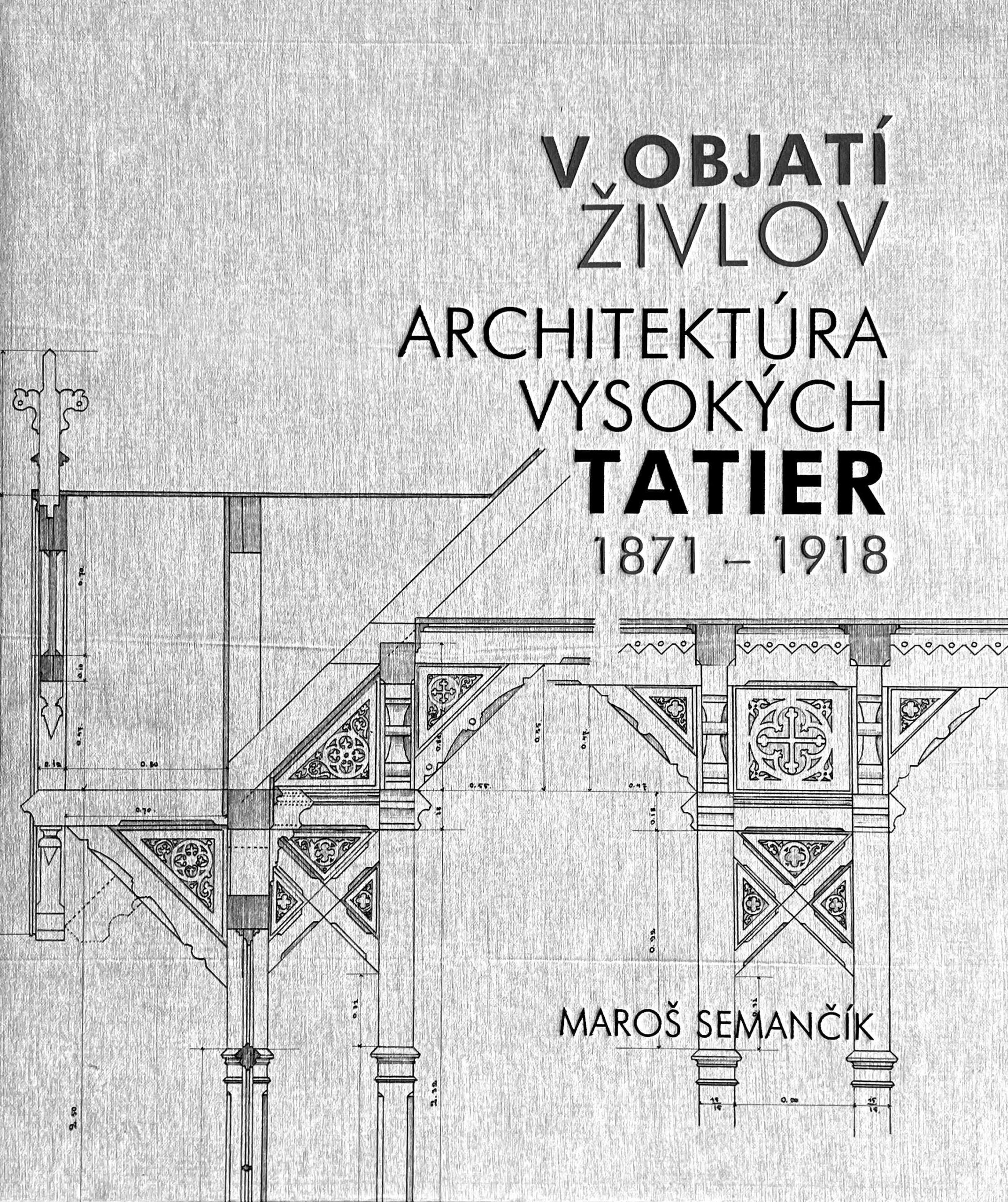
V objatí živlov.
Architektúra Vysokých
Tatier 1871 – 1918, 2020
Semančík, Maroš
OZ Belianky, Maroš Semančík
ISBN 978-80-570-2644-0
As an expression of nostalgic regret for a world whose last remnants are just disappearing, Maroš Semančík conceived his book on the architecture of the High Tatras from the time of their great construction boom, the last quarter of the 19th century. This boom began in 1871, when the section of the Košice-Bohumín railway line was opened from Žilina to Poprad-Veľká, and ended with the dissolution of the Austro-Hungarian Empire in 1918. The author makes no secret of his admiration for the picturesque eclectic architecture of the time and bitterly comments on the arrival of modernism, which meant its rapid decline and irreversible end. With considerable regret, he notes that much of what he writes about in the book no longer exists, sometimes without even a single historic photograph to document it. For some objects, “even their status as cultural monuments… sometimes failed to protect them from destruction or even physical liquidation” (p. 11). Yet even considering this popularly appealing regret over the demise of the good old world, his work goes beyond mere sentiment with a well-founded and rich argumentation based on extensive research in archives from the Tatra Mountains to Budapest, detailed knowledge of both vanished and preserved buildings and their designs, their stylistic models and specific templates, and a scientifically thorough synthesis.
From the publication indicia alone, the reader can guess that this extensive 467-page book was not easy to produce. Its author, who is highly demanding in terms of the quality of the final product, states that he completed the text in 2015 and the book saw the light of day in 2020, published partly at the author’s own expense. Yet this partial self-publication in no way detracts from it convincing authenticity. In some places, the author meticulously cites sources in almost every sentence, whether monographs and small newspaper articles, biographical works or archival documents. The visual aspect of the book is admirable, with old photographs, generously reproduced architectural drawings, and little-known portraits of a whole range of personalities.
After the introductory chapters, in which the author focuses on the genesis and occurrence of what he calls, without quotation marks, the Swiss style, he moves on to the main chapters, of which there are eleven in total. Their topics are varied and treated with in-depth analysis. It begins with the chapter “Urban Development of Tatra Settlements”, there is also a chapter entitled “Construction Methods and Customs”, where, among other things, we learn about the specific reasons for preferring half-timbered buildings, or the chapter “The Tatra Electric Railway – A Lengthy Transport Modernization”, which deals with the construction of the railway and the architecture that accompanied it.
The author devotes special attention to “Prince Hohenlohe – Builder of Hunting Lodges”, while the chapter “From Hunting Lodge to Spa” promises an analysis of the functional purpose of buildings, but focuses on describing earlier Tatra construction that predates the period under study. Maroš Semančík also devoted considerable attention to the personalities of Tatra architecture, bridging a century-long gap in Slovak literature, which tended to ignore facts about the lives and work of architects associated with the pre-1918 era of direct Hungarian rule. Hence we find a series of biographies, accompanied by thorough notes, presenting both Budapest-based architects as well as Spiš-Hungarian architects who had some influence on the Tatra region. The author devotes entire chapters to the architects with the greatest contributions, invariably those from the immediate region, either, working in Spiš, like Anton Müller and Gedon Majunke, or Guido Hoepfner, a native of Spiš working in Budapest. In the case of the former, the author notes his journey “from global romanticism to local formulations of the Swiss style”. According to the author, Majunke was responsible for “the main wave of architecture formation in the Tatras”, while Hoepfner’s work is examined in terms of “finding context”. Here, Semančík overcame his reservations about modernism when he praised one of the last works of the period under review, the former restaurant at Štrbské Pleso (completed on 1 July 1918), and its reduced forms following the shapes of the reinforced concrete structure.
In a remarkable chapter entitled “Villas belle epoque – cherchez la femme”, he deals with the contribution of women to Tatra architecture. Not out of any feminist fashion, but from empirical evidence: behind the series of Tatra villas from the Art Nouveau period were active women from the circles of the Budapest aristocracy. They played a significant role in deciding on the architectural style, and in the case of the Szikra villa in Nový Smokovec, its owner, Countess Teleki, even created the architectural design herself.
The author compares the situation on the southern, i.e., Hungarian side of the Tatras with the then Austrian-ruled side in the north, where there was only one large center, Zakopane, and where, thanks to Polish nationalist efforts, the style was more nationally cohesive than on the Hungarian side, which was more cosmopolitan and diverse. The aforementioned villas designed by women were also a distinctive and colourfully differentiated segment of this diversity. Their architecture was inspired by such diverse influences as local wooden houses, which the Tulipán villa somewhat resembles, or brick, so to speak British models, which are evident in the Szechényi villa (both in Tatranská Lomnica).
The last of the main chapters is devoted to a single building: the Palace Sanatorium by Michal Milan Harminc. It was built at the end of the period under review and, unlike the previous buildings where the architects and clients were declaredly Hungarian background, it was had a directly Slovak context, not only in terms of its author but also its builder, the Liptovský Mikuláš factory owner Peter Hupka. Semančík recalls the extraordinary significance of this now-abandoned colossus. As a staunch anti-modernist, he argues against our emphasis on the modern features of its southern facade, claiming that “the conflict between representation and purpose was only created by a modernist perspective” and that the southern terraces are of secondary importance to him because “the modern style of the sanatorium is constrained by the solid frame formed by the massive Baroque-style two-story base of the building and the distinctive mansard roof.” (p. 305)
Also receiving great attention are the highly accurate biographical notes of the architects and the collection of rich information and impressive illustrations about them. He also included architects who were significant throughout Hungary, such as Ödön Lechner and Gyula Pártos, but who designed only one building in the Tatras, and that never realized (a colonnade and restaurant in Starý Smokovec). The book concludes with a detailed list of buildings, including maps of individual locations. It should be noted, though, that the maps of the Tatra settlements are somewhat confusing for today’s reader, as only buildings from the period covered by the book are included, making it hard to orient oneself among newer construction.
The author confidently navigates the long sequence of buildings, often not only with a short lifespan, but also frequently changing their names from the original Hungarian sometimes directly to Czech after the end of Habsburg rule in 1918, and then Slovak. For example, in the case of the aforementioned Teleki Villa in Nový Smokovec, it was originally Szikraház – after 1919 Sibíř – later Sibír – (and we add that today it is again Iskra). Semančík is often forced to comment on the “change of status” euphemistically: demolished.
From the depictions in the extensive and precise “List of Objects”, we can see that the buildings’ architectural quality was variable and often quite questionable. The list does not make any distinctions between them, capturing everything without exception and building its analysis on an integrative basis. In the main chapters, he finds parallels and influences, captures the subtle fabric of local processes, evaluates quality, and critically differentiates. At the same time, it is clear from the text that the historicizing architecture of those times is close to his heart. In connection with Slovak architecture, we often encounter the adjective “peripheral”. We tend to either defend it or resignedly acknowledge that it did not produce any external stimuli and remained dependent on what came from the cultural centers, whether Budapest or Prague. But what then is the position of such a marginal, peripheral enclave as the wild and long-uninhabited High Tatras mountain range? Here, construction and architectural impulses also arrived from centers much further afield, both primary and secondary, from Switzerland, from European metropolises, from Budapest, or from the adjacent, and itself completely peripheral Spiš region. It might seem that in such a multiply marginal environment it is impossible to examine any internal movements and laws governing the emergence of architecture, that it is always just a mechanically derived echo of distant impulses.
Semančík is fully aware of these external influences, thoroughly analyzing the Swiss style and detailing the significant influence of Budapest. He also likes to refer to specific examples of buildings that may have inspired the given solution. Sometimes he is perhaps too bold in identifying the imitated model, as the stimuli may not always have been so specific and may have been based on the overall stylistic conventions of the period. It seems that architects register models and patterns in a general rather than a detailed and faithful form.
The aptly illustrated parallels are appealing to the reader, but they may lead to the assumption that they are direct copies. For example, in Branisko II (p. 105), three quasi-models exist, but the appearance of the realization underwent locally conditioned changes: the architect designed something slightly different from what was built, and the later backdrop of the wooden veranda turned out a little differently. However, it must be acknowledged that where it is clearly “literal and deliberate plagiarism”, such as in the case of Majunke’s Roman Catholic church in Tatranská Lomnica (p. 153), the author is unafraid to mention it, although the reason behind the plagiarism is unknown even to him.
Maroš Semančík delves deeply and with great interest into the complex web of external and local influences, reactions and resulting solutions, and their conceptual and implementation background. Through his analyses, he proves that even in such a small and multiply peripheral environment as the High Tatras, it is possible to relate their architectural stories with competence and attrac- tively present their complex internal structure, revealed not merely as a derivative of stories in cultural centers but an active agent that dreamed up its own retelling of these stories.
This paper was partially supported by the VEGA agency
(Grant no. 1/0063/24).

This work is licensed under a Creative Commons Attribution 4.0 International License