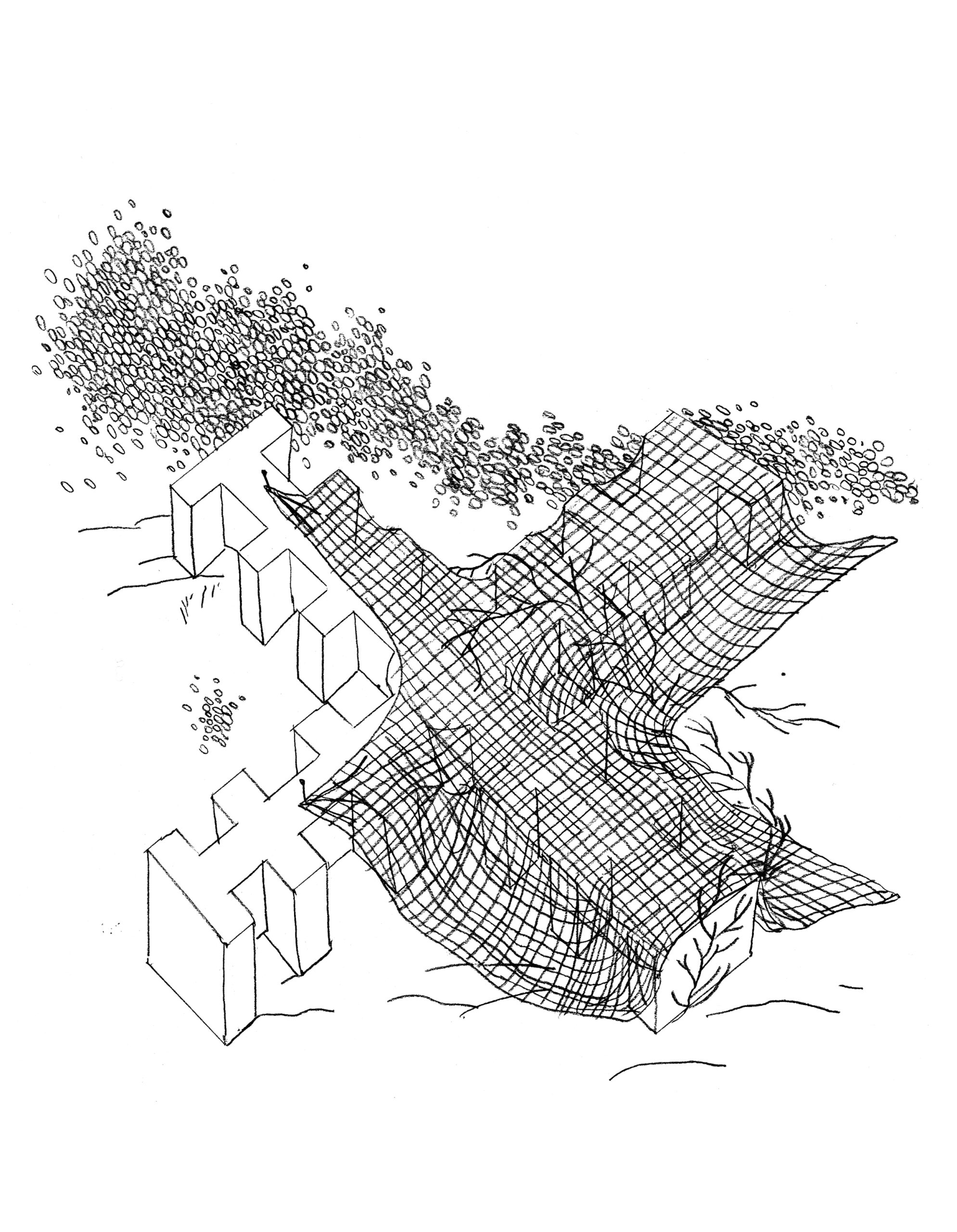
Le Corbusier’s Towards a New Architecture is usually read as a manifesto promoting an engineering approach to architecture that is also a “limpid and impressive plastic fact”. Yet its complexity allows for further interpretations, including the neglected perspective of architecture’s relation to the landscape. The text contains numerous statements on the building-landscape relationship, urban planning and greenery, and the integration of house and garden. This study examines the manifesto from the viewpoint of landscape and garden architecture to enrich our understanding of Le Corbusier’s thinking, which existing literature has addressed more through his projects rather than his writings.
Le Corbusier’s manifesto Vers une architecture is usually read, in line with the opening “Arguments”, as a text advocat-ing an engineering-based view of architecture, intended to remain a “limpid and impressive plastic fact”. However, the complex nature of this key manifesto of modern architecture offers many other possibilities of interpretation. One of those hitherto rather neglected, though now highly topical, is the relationship between architecture and its surroundings, whether natural landscape or its urban counterpart. The manifesto contains a number of statements on the relation-ship between the architectural object and the landscape, on urban planning in relation to landscape and green space, and on the integration of buildings and gardens. Analyzing Corbusier’s manifesto from the perspective of landscape and garden design as an integral part of architecture should contribute to its expanded interpretation and to the under-standing of the sources of modern approach to landscape, garden and urban public space.
The Manifesto and Its Versions
Corbusier’s manifesto Vers une architecture, first published in 1923, comprises a collection of texts written between 1920 and 1923 and published (except for the last chapter, “Architecture and Revolution”) in the magazine L’Esprit Nouveau. Attracting unprecedented attention from ar-chitects and the public, it sold out less than a year after its launch, and a second edition, revised and expanded, appeared before the end of 1924. The revised edition (thir-teenth printing) became the basis for Frederick Etchells’ first English translation of 1927, titled Toward an Architec-ture and subsequently published in numerous re-editions, most recently in 2014 as a reprint of the original edition.1 The second edition was also chosen for translation by the editors of the “Texts & Documents” series published under the auspices of the Getty Research Institute in 2007.2
In the following paper, I consider both the first and sec-ond editions of the manifesto, mainly because the changes made in the second edition are immediately relevant to the topic investigated. Le Corbusier provided the second edition with his own preface, which illustrates the dynamic development of his theoretical thinking, especially on urban themes. In this revised edition, he amended some of his formulations, added illustrations, and above all, ex-panded the chapter on mass-production housing by thirteen pages, which present, among others, his vision of a new type of garden city and the Cité Frugés project for Bor-deaux-Pessac. In the case of the first edition I rely on the Czech translation,3 in the case of the second edition on the English translation by John Goodman, published in 2007 by the Getty Research Institute under the title Toward an Architecture. The quoted formulations were also compared with the French version of the second edition to ensure critical comparison of the individual language versions and possibly avoid misunderstandings in interpretation.4
Nature and Landscape as a Plastic Form
In the preface to the second edition, Le Corbusier writes that the great professional and public interest in the first edition heralds the arrival of a new era that needs to “build its house. A house that will be this human boundary that encloses us and separates us from antagonistic natural phenomena, giving us, we men, our human milieu.”5 Nature, in his view, is anta-gonistic to man, but at the same time is endowed with a kind of universal order: “A plan proceeds from the inside out, for a house or a palace is an organism similar to any living creature.”6 These words can be read in at least three ways: as an affirmation of the primacy of nature, as a statement about man and his creation as a part of nature, but perhaps also as a proud statement of man equating human creation with the extra-human, that is, with “all living creatures”.
Several authors have pointed to the ambiguous nature of Corbusier’s texts, the internal contradictions so often present in his statements. Kenneth Frampton offers an expla-nation based on an interpretation of the religious tradition of Corbusier’s ancestors, namely the “distant Albigensian background of his otherwise Calvinist family”, considering it a “latent Manichaean view of the world which may well have been the origin of his ‘dialectical’ habit of mind.” He refers to the “ever-present play with opposites […] that per-meates his architecture and is evident as a habit of mind in most of his theoretical texts.”7 If we read Corbusier’s texts carefully – applied not only to his early 1920s manifesto but also his later writings – we will see that nature is understood as antithetical to, or even transcending humanity, but can nevertheless be controlled to some extent by the human gesture, and thus included in the human world.8
Le Corbusier sees the natural landscape – meaning the landscape as a natural formation conceptualized through visual perception – as a “magnificent play of volumes brought together in light”,9 to borrow his famous quote concerning architecture. The question of landscape as a plastic environment is developed in his key manifesto, particularly in the chapter “Architecture. The Illusion of the Plan”: “…in architectural spectacles, the elements of the site intervene by virtue of their cubic volume, their density, the quality of their materials, the bearers of sensations […] The elements of the site rise up like walls rigged out to the power of their ‘cubic’ coefficient, stratification, material, etc., like the walls of a large room.”10 As such, the land-scape participates, or rather, human agency participates with the landscape to produce a harmonious whole. Evi-dence is offered by the caption to the plan of the Athenian Acropolis: “The seeming disorder of the plan will fool only the profane. The equilibrium is not small-minded. It is determined by the famous landscape that extends from Peiraeus to Mount Pentelikon. The plan is conceived for distant views: the axes line up with the valley and the slight-ly canted angles are the skilled interventions of a great stage director.”11 However, in the photograph of the Parthe-non, he attributes to man the domination of the landscape, which, as a natural formation, is fully incorporated into the human world, or rather becomes part of the human creation: “Temples were raised on the Acropolis that are of one mind and that swept up the desolate landscape and made it serve the composition. So from all along the ho-rizon’s rim, the thought is one.”12
It seems that Le Corbusier saw the natural landscape architecturally, as an interplay of spaces and volumes, con-centrating his attention on its morphology rather than its more mutable, living and vegetal elements. To what extent this is a legacy of his childhood and youth spent in the moun-tainous alpine landscape of his Swiss birthplace, we can only guess. Corbusier himself, however, gives us permission to do so with his recollection, published in a book forming a direct sequel to his manifesto: “Nature was the setting where, with my friends, I spent my childhood. Besides, my father was passionately devoted to the mountains and the river which made up our landscape. We were constantly on the mountain tops; the long horizons were familiar.”13 While Corbusier’s ideas on the relationship between architecture and the natural landscape are probably rooted in his native land and the journey to Greece he took on his grand tour of Europe in 1911, which left a lasting mark on his memories and his imagination, his innovative thoughts on the urban landscape have a purely architectural pedigree.
Vision of a New Urban Landscape
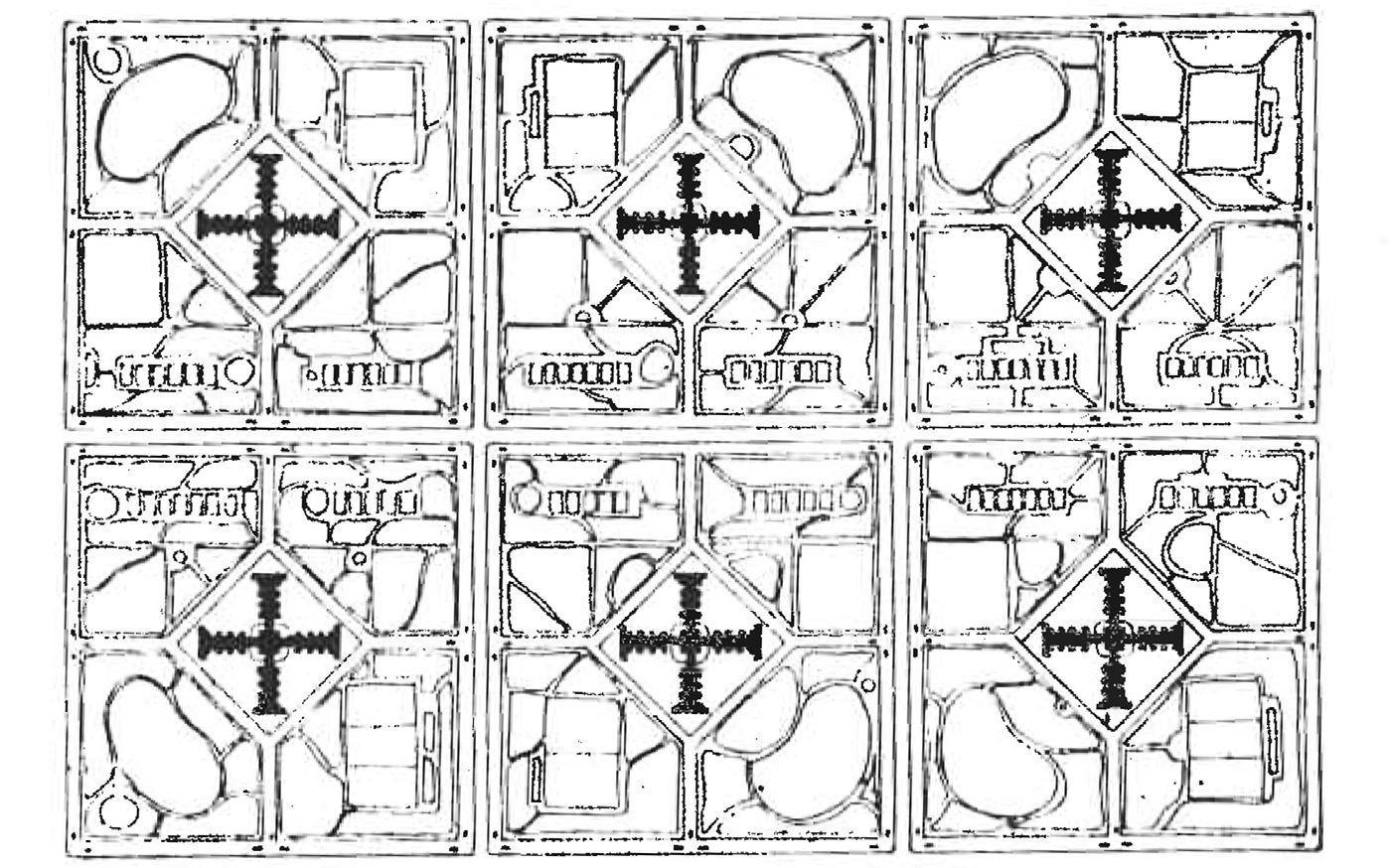
We have already seen how Le Corbusier, in the text of Vers une architecture, refers to the natural landscape and its plastic volume to which architecture responds. On the following pages we will consider his construction of a con-cept of a new urban landscape – as distinct from the natural one – to be grounded in a rational geometric order. The sources for our consideration can be found primarily in the chapter “Three Reminders to Architects: Plan” and in the chapter “Mass-Production Housing” of his manifesto. Le Corbusier does not treat the urban landscape as a sep-arate problem, but entirely in relation to the question of housing, presented as the central problem of architecture on which “social equilibrium depends”.14 For Le Corbusier, the plan is an essential means of eliminating the “filth and incoherence”15 that plague contemporary industrial cities. He cites Tony Garnier’s 1904 Cité industrielle, an ideal city project based on the principle of the garden city, as a prototype for modern industrial city living, praising it as “a conjugation of utilitarian solutions with plastic solu-tions” and “practical order” because “Where order reigns, well-being is born”.16 Well-being, or bien-ȇtre in French, is intimately connected to a person’s experience of life and, in conjunction with order as a condition for establishing this well-being, refers to the key role of discipline in hu-man life. The rich greenery in the streets and around the houses is intended to contribute to the bien-ȇtre of the inhabitants of the industrial garden city. In the caption to Garnier’s drawing of the residential district in the Cité industrielle, Corbusier extols its virtues, adding at the end: “And the surface of the city is like a large park.”17 Corbusier then presents his vision of the Tower-Cities, referring to Auguste Perret’s idea of the city of the future. Corbusier proposed tower cities as an alternative to con-temporary Paris and large metropolises in general, “in which apartment buildings pile up, all crammed togeth-er, and narrow streets interweave, full of noise, gasoline stench, and dust, and where the floors are completely open to inhale this filth”.18 Thanks to the “crucial constructional event” of the American skyscraper, it will be possible to accommodate the same number of residents in high-rise buildings occupying a much smaller footprint. Tens of thousands of inhabitants would enjoy clean air in high-rise buildings on a cross-shaped plan, free-standing in ample spacing amidst greenery. “Hausmann, instead of making narrow thoroughfares in Paris, would have demolished entire neighbourhoods and condensed them vertically; then he would have planted parks more beautiful than those of the Grand Roy,” Corbusier writes in the text below the proposed plotting of a tower city, dated 1920, and adds in another drawing of the same page that compares a section of an ordinary apartment block with a tower city: “The whole city is covered with greenery.” However, we do not see the greenery in the section, but only imagine it in the thin undulating line floating just above ground level.19
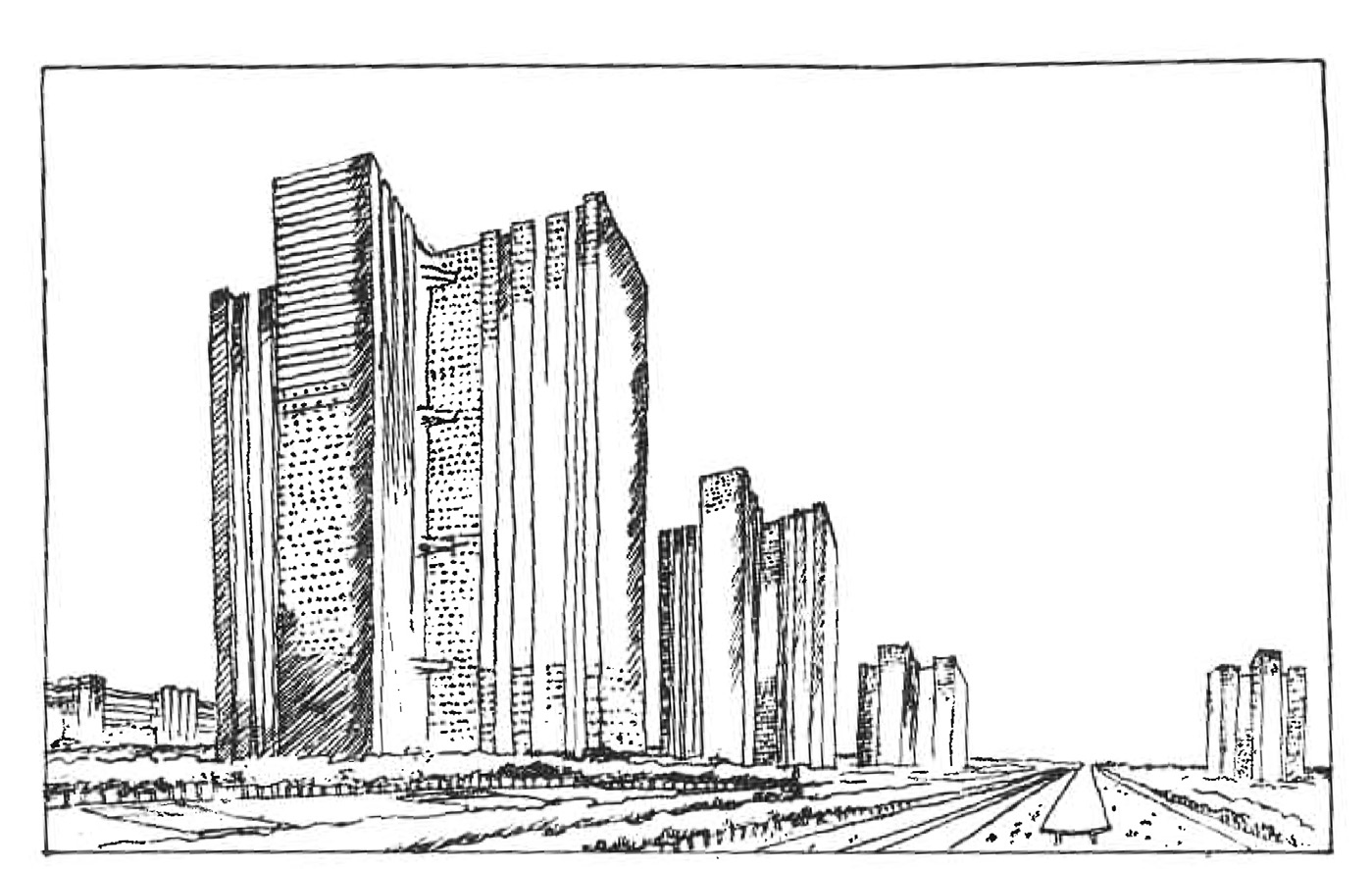
If the whole city area is to be one large park, the actual appearance of this new park is not specified: the manifesto speaks of lawns, trees and greenery in general, with oc-casional mention of flower beds and sports fields. These tree-lined park areas will include tennis courts and sports facilities in the immediate vicinity of the buildings: “At the foot of the towers, parks unroll; greenery extends over the entire city”.20 The tower blocks will stand “amidst gardens and playing fields (sports, tennis, soccer)”,21 as the caption to a drawing in this chapter says, but in this drawing we only recognize trees planted in lines along the expressways. The desired greenery is only schematically hinted through the tiny treetops crouching at the base of the giant buildings. One could almost say that Corbusier was trying to stand-ardize not only construction but also greenery. However, we must equally recall his affinity to French culture, where the landscape and horticultural tradition is characterized precisely by the geometric control of natural elements, linear planting, ornamental parterres and clipped trees. The strict orthogonality of Corbusier’s drawings of urban projects presented in Vers une architecture, as well as elsewhere, can be seen as a matter of expressing human control over nature, or as an effort “to reconcile man and nature through a strict orthogonality expressed by the grid of the plan”.22
The grid, however, refers only to the basic urban layout. If we look at the drawings more closely and pay attention to the areas between the houses and the expressways, we find schematically indicated circular park paths in organic curves, as was usual in traditional contemporary park lay-outs. It is interesting that a visionary of Corbusier’s calibre provided his bold tower cities with parks that in their layout strikingly resemble the peaceful bourgeois quarters or the layout of eclectic urban parks of the late 19th and early 20th centuries. On the other hand, it should be remembered that avant-garde garden concepts of purely modernist aesthetics, such as those implemented by Gabriel Guevrekian at the Vil-la Noailles in Hyéres (completed in 1927) or at the Exhibition of Decorative Arts in Paris in 1925, were not yet the order of the day in the early 1920s, and horticultural design generally remained in the grasp of the eclectic Beaux-Arts tradition. Similarly, greenery (Corbusier often uses this generic word, la verdure) is treated schematically in the drawings and sketches for the other two urban concepts he presents in the chapter “Three Reminders to Architects: Plan”. The Pilotis-City is dated 1915 in the second edition of the mani-festo, whereas the first edition merely states that “I had al-ready presented this concept of a city on pilotis to Auguste Perret”.23 It was a concept of houses on a much smaller scale, much lower than those of the Tower City, which would be raised on concrete columns above the ground and have water, gas and sewer pipelines running underneath. Traffic would be moved to the elevated ground-floor level of the buildings, while cafes and shops, as well as greenery, would have their place on roof terraces that would provide a kind of substitute for urban street life. It is not without interest that in the second edition this chapter, devoted to the plan, was printed with minimal textual changes but a newly added illustration at the end: the photograph of the roof garden of the house in Auteuil (Le Corbusier and Philippe Jeanneret are credited as the authors), evidently intended to show how the flat roof area can be used for an ideal resting place, overlooking the treetops.
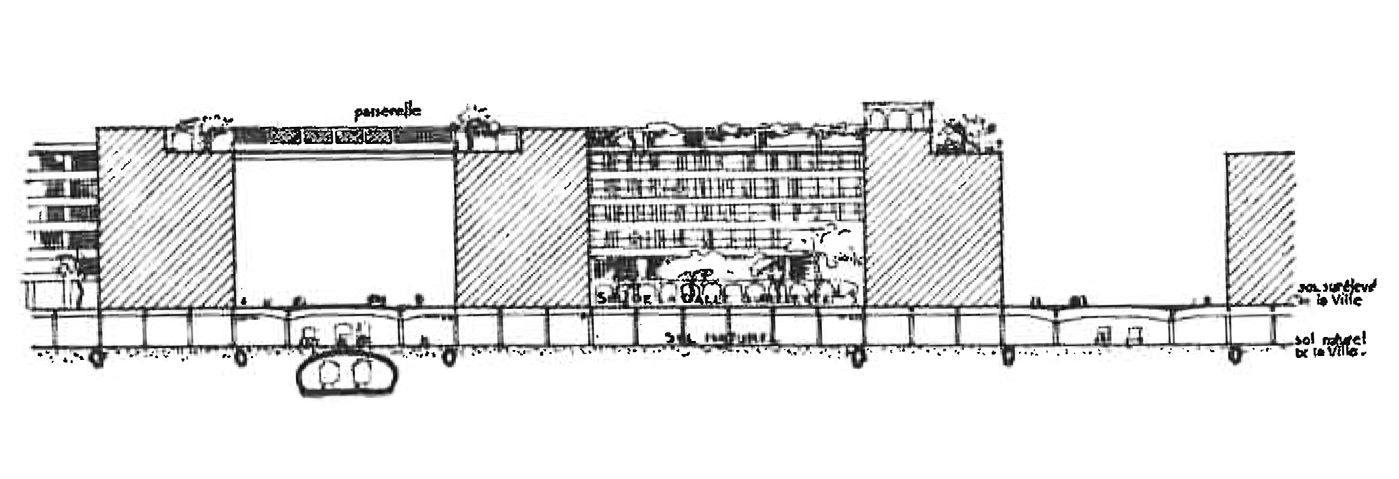
Finally, the concept is presented of Streets with Indents, a layout that would replace the enclosed, poorly ventilated blocks with houses like successive indents snaking along the main street. These houses were themselves to be surrounded by greenery, gardens and playgrounds. As with Tower-Cities, Corbusier illustrates his vision with his own drawing of the view and plan, with schematically drawn parkland. Again, the layout is strictly symmetrical, with individual park areas bordered by tree lines that define rectangular areas of lawn with organically shaped paths and a rectangular playground (?) area near the house. After all, what is at issue here is not the park but instead the plan: a plan that Le Corbusier sees as the key to a new architecture yet to emerge. The old base of architecture is dead, he judges, and continues, “There will be no rediscovery of the truths of architecture until new foundations have become the logical support of all architectural manifestations. The next twenty years will be taken up with creating these foundations.”24
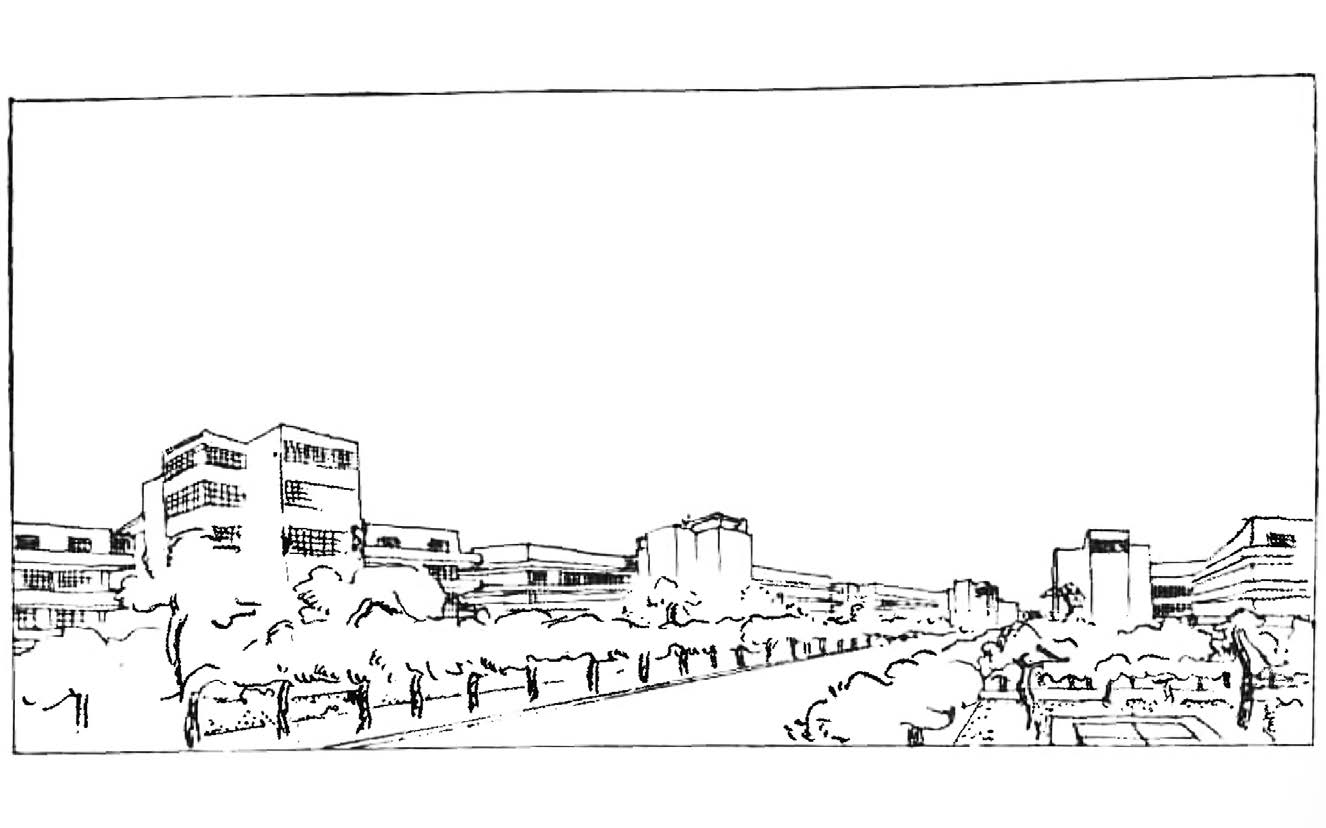
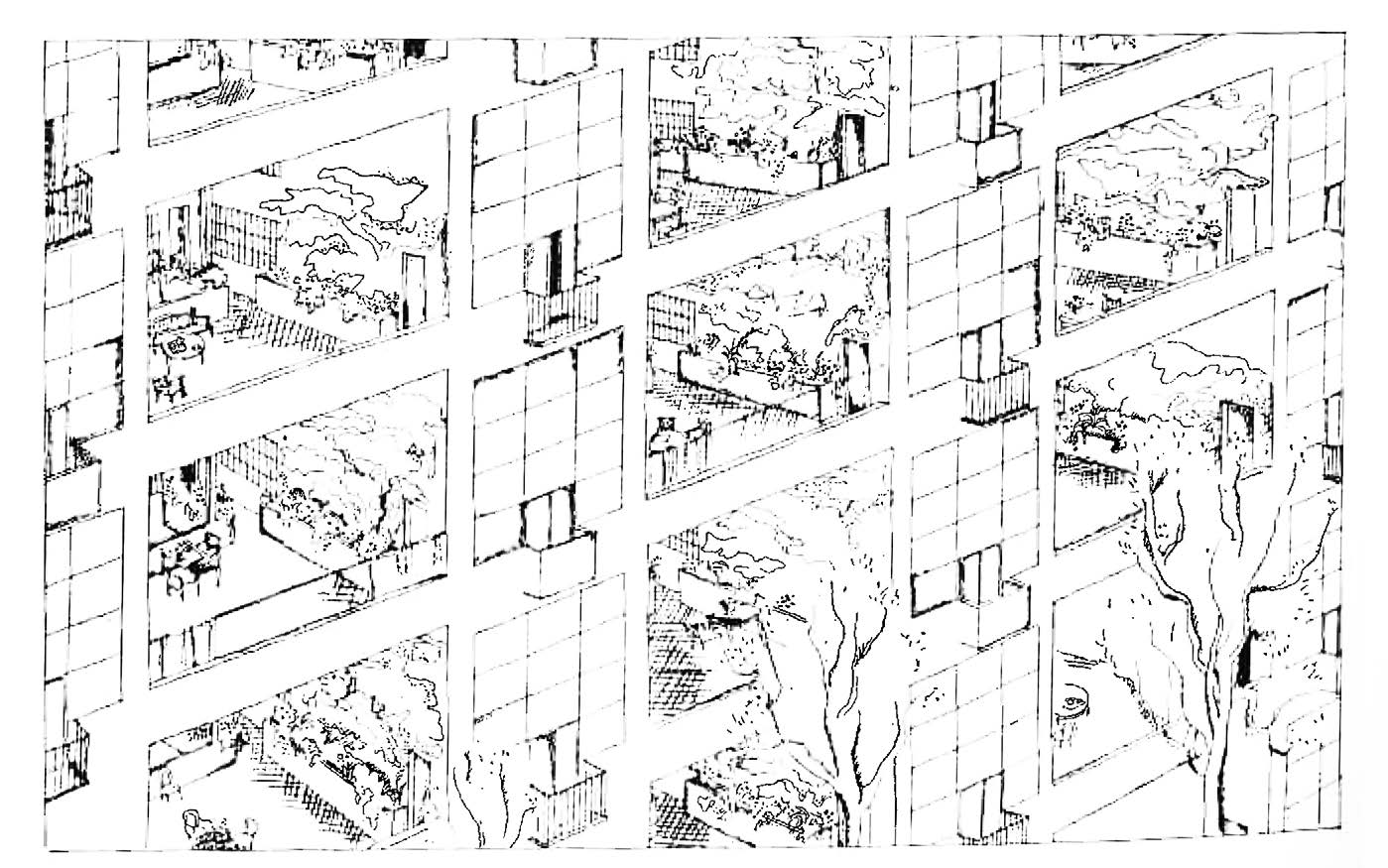
Further visions of new housing in green spaces can be found in the penultimate chapter of the manifesto book, titled “Mass-Production Houses”. Containing more draw-ings and plans than text, it presents Corbusier’s designs for mass housing through typified and standardised hous-es. Most interesting for our topic here is the Immeuble-Vil-las concept: a residential building composed of separate units, “villas” of two floors, each with its own hanging garden in a loggia that offers complete privacy. The two drawings show the loggia as a habitable outdoor space with relatively abundant vegetation, probably located in built-in beds and schematically indicated on the drawing. Operationally, it was a concept of a serviced collective housing with a central kitchen, common sports facili-ties and a hall on the roof as well as tennis courts in the courtyard. “Trees, flowers all around the courtyard, and all around the street in the gardens of the villas. On all floors, ivy and flowers in hanging gardens.”25
In the chapter on mass-production houses, thirteen new pages were added in the second edition, in which Le Cor-busier presents mainly his projects for Bordeaux, commis-sioned by the local industrialist Henry Frugés and already in progress by the time of publication. These include a garden city – a residential development in Bordeaux-Pessac – and a villa in Bordeaux. A project for university student housing in self-contained cells with roof gardens is also briefly intro-duced. However, the general vision of a new garden city is by far the most interesting for the topic under investigation, and is presented as an introduction to the Cité Frugés pro-ject with only one drawing and its comprehensive caption. This idea of a new garden city is probably the most extensive, or rather the most detailed vision of a new landscape arrangement that Corbusier presents in his manifesto. The drawing shows a panoramic view of apartment blocks in greenery, long three-storey build-ings whose facades may remind us of Immeuble-Villas, and is accompanied by a caption worth quoting in full: “Let us analyse the 400m2 of terrain allocated to each inhabitant of a garden city: house and dependencies, 50 to 100 m2; 300m2 are allocated to lawns, orchards, veg-etable gardens, planted parterres, vacant land. Mainte-nance of that is difficult, costly, taxing; yield: a few boxes of carrots and a basket of pears. There are no playing fields, children, men and women cannot play, cannot do sports. Sports should be an option every hour of every day, and they should be possible right outside the house and not at stadium grounds where only professionals and the idle go. Let us pose the problem more logically: house 50m2; pleasure garden 50m2 (this garden and this house are situated on the ground floor or 6 or 12 metres above the round, in so-called honeycomb clusters). Right outside the houses, vast playing fields (soccer, tennis, etc.) at a rate of 150 m2 per house. In front of the houses (at a rate of 150 m2 per house) land for industrialized farming, intensive farming with substantial yield (irriga-tion by pipes, cultivation by a farmer, carts for fertilizer and transport of soil and crops, etc.). A farmer sees to surveillance and administration for each group. Sheds protect the harvested crops. Agricultural labor abandons the countryside; with the eight-hour shift, the worker here becomes a farmer and produces a significant portion of the things he consumes. Architecture, urbanism? Logical study of the cell and its functions relative to the ensemble provide a solution rich in consequences.”26
Towards a (New) Landscape?
To what extent was the legacy of Corbusier’s manifes-to applied and developed further in relation to urban landscapes, parks and gardens? As mentioned in the introduction, Corbusier’s work has until recently been reflected almost exclusively in the context of architecture and urbanism, with the theme of the relationship to na-ture and landscape design only emerging in the past few years. Architectural theorists and historians have typically interpreted Corbusier’s work, including his writings, as antagonistic to nature, while the postmodern reckoning with the legacy of modern urbanism and the postulates of the Athens Charter has only reinforced this tendency. In architectural theory, the emergence of interdiscipli-nary approaches at the end of the 20th century gave rise to stimulating reflections that touch on the theme of rational linearity favored by the modern and the organic mani-festations of life in an expanded perspective. Catherine Ingraham writes in her essay “The Burdens of Linearity.
Donkey Urbanism” from 1988: “Orthogonality keeps culture hegemonically superior to nature and attempts to obliterate the trace of nature in culture”27 Marc Treib, a leading theorist and historian of landscape architecture, notes in 1993 that “Modernist architects such as Le Cor-busier regard the landscape and plant materials almost as generic greenery, returning as a subject to be viewed or serving as the vegetal buffer between buildings.”28 It cannot be denied that Corbusier’s vision of the new urban landscape is an architectural vision: when Cor-busier speaks of greenery, parks and gardens, it does not sound like a musing of a landscape architect for whom vegetation and its growth are the primary material. He always thinks of plants in architectural terms, as a means of shaping architectural space, not as landscapes in the sense of the complex creation of public spaces and parks, and certainly not in the sense of a work of landscape architecture. “Greenery”, in turn, remains essentially a building material meant to perform certain functions, primarily hygienic, and aesthetic in the modern sense, too. Only recently have publications appeared interpreting Corbusier’s work from the perspective of its relationship to landscape and nature, in connection with the increased interest in environmental issues and the rise of landscape architecture. One of the first attempts can be found in Eco-logical Architecture. A Critical History by James Steele, published in 2005. However, the chapter on Le Corbusier concentrates on his later work from 1935 onwards and the earlier work is mentioned only in passing. In fact, the chapter is titled “Le Corbusier: The Retreat from Pur-ism”.29 The most extensive research to date on this topic was undertaken by Jean-Louis Cohen and Barry Bergdoll, who in 2012 curated jointly the exhibition Le Corbusier: Atlas of Modern Landscape at the Museum of Modern Art in New York, accompanied by a publication of the same name.30 In their book they show, mainly through an anal-ysis of projects both built and unbuilt rather than texts, how Corbusier’s relationship to landscape and the natural environment evolved, revealing this lineage as significant in Corbusier’s work. Their conclusions make it clear that this topic requires further attention and that rethinking the hitherto dominant view of Corbusier’s work will be one of the fundamental tasks of architectural theory and history. Landscape architects and theoreticians are also begin-ning to embrace Corbusier’s legacy and rethinking it. In Landscape Architecture and Infrastructure in the Twenti-eth Century, one of the first attempts to inventory the key works of modern landscape architecture internationally, the editors appreciate Corbusier as one of the major archi-tects of the interwar era who deeply influenced landscape design in the twentieth century.31 The modernist approach to landscape design on the city scale is evaluated by the editors and authors of this publication in less radical terms than by the critics of the modern movement, and they acknowledge the contribution to the quality of life through the successful implementations, particularly from the postwar period, that draw on Corbusier’s ideas: “New and comprehensive city-scale interventions reveal the prevalence of functional planning, rational designation of land use and circulatory systems, new boulevards, and the pragmatic use of vegetation to achieve visual harmony, amenity and climatic-responsive design.”32 These goals and many others are fulfilled by Corbusier’s vision of the new garden city as an agricultural production unit, presented succinctly in the second edition of Vers une architecture. It is only today that we can say that this mi-nor reference to a vision of a new organization of land use in an urban landscape anticipates in a remarkable way the possibilities of so-called urban agriculture, which have only become relevant in recent years. Undoubtedly, in the current climate crisis, Corbusier’s century-old reflections on the integration of “greenery” and architecture deserve more attention than they have received so far.
Doc. PhDr. Jana Tichá, PhD.
orcid: 0000-0001-7450-5536
Dept. of Theory and History of Architecture Faculty of Architecture
Czech Technical University Prague Thákurova 9
166 34 Praha 6 Czech Republic jana.ticha@fa.cvut.cz
LE CORBUSIER. 2014. Towards a New Architecture. East-ford, CT: Martino Fine Books.
LE CORBUSIER. 2007. Toward an Architecture. Los An-geles: Getty Research Institute.
LE CORBUSIER-SAUGNI-ER. 2004. Za novou architekturu. Prague: Nakladatelství Petr Rezek.
LE CORBUSIER. 1924. Vers une architecture. Nouvelle edition revue et augmentée. Paris: Éditions G. Crès.
Le Corbusier, 2007, p. 83.
Le Corbusier, 2007, p. 216.
FRAMPTON, Kenneth. 1985. Modern Architecture. A Critical History. London: Thames and Hudson, p. 149.
For an analysis of Le Corbusier’s relation to natural landscape as manifested in his writings from 1920s to 1960s, see TICHÁ, Jana. 2023. Linie horizontu. In: Vorlík, P. (ed.). Le Corbusier +. Prague: Faculty of Architecture CTU, pp.14–21. So far available in Czech only.
Le Corbusier, 2007, p. 102.
Le Corbusier, 2007, p. 224.
Le Corbusier, 2007, p. 121.
Le Corbusier, 2007, p. 234.
LE CORBUSIER. 1987. The Decorative Art of Today. Cambridge, MA: MIT Press, p. 194. The French original version L’art decoratif d’aujourd’hui appeared in 1925, its publication is announced by Le Corbusier in his introduction to the second edition of Vers une architecture, along with the publication of Urban-isme, as two new books written simultaneously and witnessing two distinct lines of his thought.
Le Corbusier, 2007, p. 88.
Le Corbusier, 2007, p. 122.
Le Corbusier, 2007, pp. 121–122.
Le Corbusier, 2007, p. 122.
Le Corbusier, 2007, p. 125.
Le Corbusier, 2007, p. 124.
Le Corbusier, 2007, p. 126.
Le Corbusier, 2007, p. 125.
DUMMETT, Emma. 2008. Order in Nature: Le Corbusier’s early work and his city plans of the 1920s. Edinburgh Architec-ture Research, 31, p. 46.
Le Corbusier-Saugnier, 2004, pp. 44. Translation by the author.
Le Corbusier, 2007, p. 130.
Le Corbusier, 2007, p. 275.
Le Corbusier, 2007, pp. 276–277.
INGRAHAM, Catherine. 1998. The Burdens of Linearity. Donkey Urbanism. In: Hays, M. K. (ed.). Architecture Theory Since 1968. Cambridge, MA: MIT Press, p. 646. Catherine Ingraham’s paper was originally presented in 1988 and revised for the 1998 edition.
TREIB, Marc. 1993. Introduction. In: Treib, M. (ed.). Modern Landscape Architecture. A Critical Review. Cambridge, MA: MIT Press, p. ix.
STEELE, James. 2005. Ecological Architecture. A Critical History. London: Thames and Hudson, pp. 95–106.
COHEN, Jean-Louis and BERGDOLL, Barry. 2012. Le Corbusier. Atlas of Modern Landscape. London/New York: Thames and Hudson.
HANRAETS, Jan, SANIGA, Andrew and CENGIZ, Gulnur (eds.). 2024. Landscape Archi-tecture and Infrastructure in the Twentieth Century. Selections from the Docomomo Chapters. Delft: Delft University of Tech-nology, p. 25. doi: 10.52200/doco-momo.books.
Hanraets, J. et al., 2024, p. 26.
DOI: https://doi.org/10.31577/archandurb.2025.59.3-4.4

This work is licensed under a Creative Commons Attribution 4.0 International License