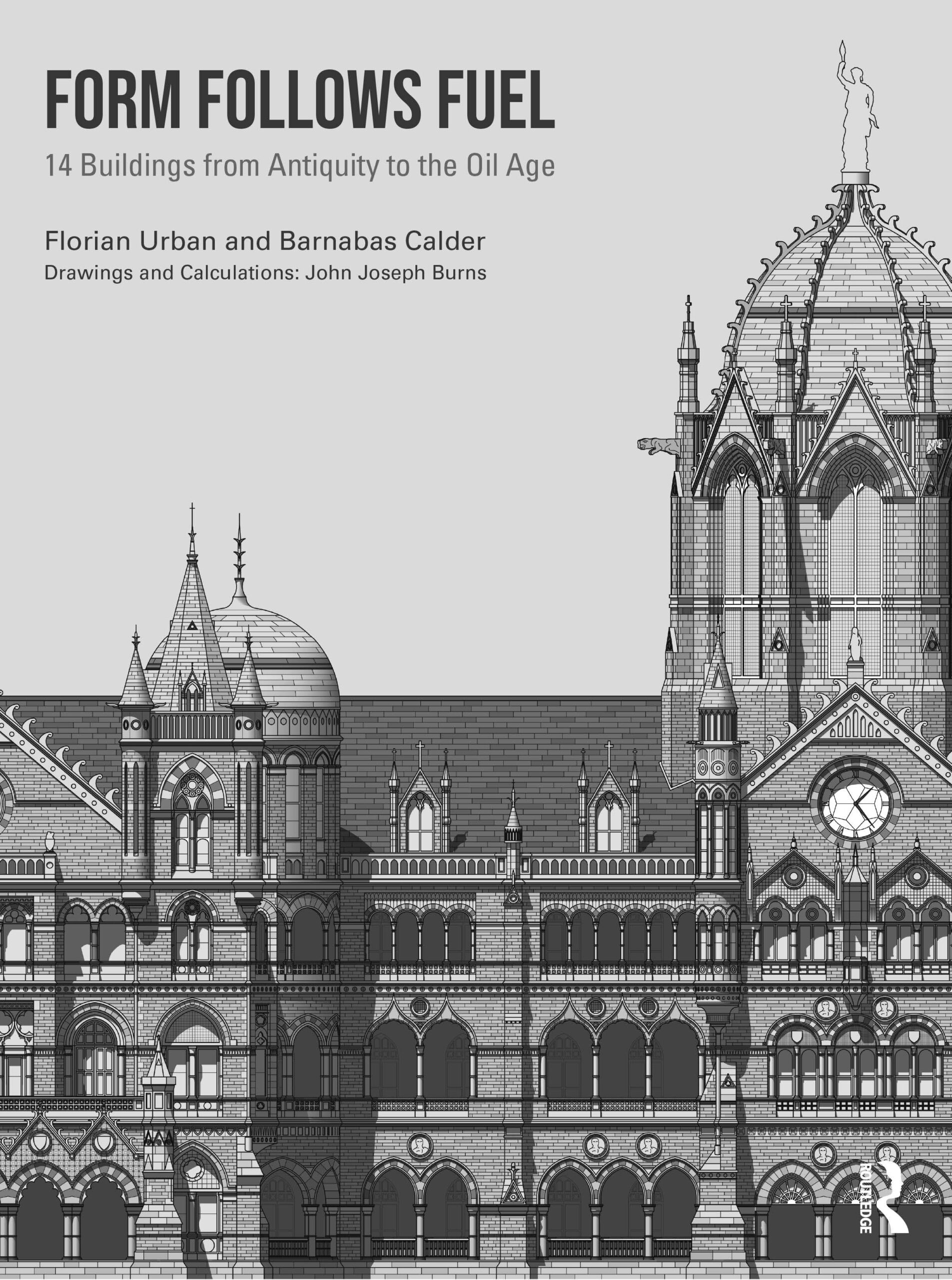
Form Follows Fuel:
14 Buildings from Antiquity
to the Oil Age, 2025
Urban, Florian and
Calder, Barnabas;
drawings and calculations
by John Joseph Burns
Abingdon, Oxon/New York,
NY: Routledge
ISBN 978-1-032639-88-8
Our current situation confronts us with our inability to slow down global warming. Decarbonization targets negotiated at the global level are becoming increasingly vague,1 while by contrast, the climate-denial scene is growing, undermining scientific consensus in society and weakening the possibilities of reaching the agreement necessary for effective climate action.2 Furthermore, research in fields seeking pathways to decarbonization – including architecture and urbanism – is also stagnating. Many works merely repeat long-discussed technical solutions and fail to offer new perspectives or socially convincing concepts – more frequently resembling greenwashing or marketing strategies than sincere efforts to reduce CO2 emissions.
However, the recently published book by Florian Urban and Barnabas Calder, Form Follows Fuel, shows the emergence of research that brings a new perspective on the current situation in sustainable architecture, as well as the broader history of architecture as such. Rooted in architectural-historical research, the authors’ perspective introduces a fresh concept into the historiography of architecture, which they aptly define at the beginning of the book: “The history of architecture can be told as a history of energy.” (p. 2) As the title of the book paraphrases the famous credo “Form follows function”, it has something of the character of a manifesto, like Louis Sullivan’s original article. The authors do not claim any intent to “displace or dismiss other forms of historical inquiry” (p. 2). Nevertheless, their conceptual ambition clearly exceeds the scope of merely adding another perspective to the interpretation of architectural history.
One of the authors, Barnabas Calder, already demonstrated the vitality of this conceptual approach in his previous publication, Architecture: From Prehistory to
Climate Emergency.3 In that book, Calder, from the Uni- versity of Liverpool, developed a comprehensive narrative about energy in architecture – from the dominance of carbohydrates in the diet, which for millennia generated the energy of human and animal muscles used in construction, to the fossil fuels that have been the primary energy source for the production and operation of architecture
over the last two centuries.
Examination of the dominant energy sources used in the construction and operation of buildings also reflects broad socio-political and aesthetic transformations. In this narrative, architecture is a material testimony – and, it should be added, a key one – to how energy shapes our world. Form Follows Fuel, which Calder wrote with Florian Urban from the Glasgow School of Art, does not offer a continuous historical narrative; instead, through case-by-case analysis of 14 architectural works, it systematically reveals and compares non-fossil and fossil architecture. From the Pyramid of Khufu to Kuala Lumpur International Airport, the authors show how the forms of energy used are inscribed into architecture itself. The case studies analysed include not only “iconic” works of world architectural history, but also representatives of prevailing typologies – such as the Scottish blackhouse or the Moscow Khrushchevka.
Though clearly illustrating the rapid rise of fossil-fuel architecture contributing to climate disruption, the buildings compared in the book present more than a uniformly pessimistic image of a warming future. The analyses suggest that fossil architecture represents merely one possible trajectory, especially when compared with the non-fossil concepts tested across millennia of architectural development.
The core of the analyses – developed in collaboration with John Joseph Burns – lies in examining the physical properties and energy intensity of the 14 selected works. Since data commonly available for contemporary buildings does not exist for most historical cases, the authors draw on in-depth archival research, contemporary measurement, and detailed knowledge of material composition.4 They have created a functional methodology that synthesizes numerous specialized studies by archaeologists and architectural historians concerning specific buildings, construction processes, and materials. On this basis, they compiled a precise model for calculating energy consumption, centred on determining the energy intensity of producing individual building materials and structural elements.
One interesting finding is that the energy intensity of building-material production has changed significantly throughout history. Today, the fossil-fuel energy costs for many materials are lower than in the past, whereas wood – generally considered a sustainable material – is now energy-hungry: harvesting it, drying it, and producing its adhesives and synthetic resins consume up to onethird of the energy required to produce iron (pp. 282–287). Another crucial criterion in historical structures is theenergy expenditure of human and animal labour. The
authors analyse both aspects in detail and supplement them with two extensive appendices.
This precise mathematical definition of energy inputs supports the book’s central thesis on operational and embodied energy. If contemporary architecture focuses primarily on reducing operational energy, Urban and Calder emphasize, by contrast, the importance – and scarcity – of embodied energy: the energy already expended, which should be considered in every sustainable building
project. Their findings confirm the slogan “the greenest building is one that already exists” (p. 274) and demonstrate that the transformation of architecture cannot rely solely on high-performance technologies and sophisticated new construction, but must be based foremost on the reuse of the existing building stock.
Regarding current architectural production, the authors point out that the embodied and operational energy of today’s office buildings and residential complexes, built using standard construction methods, does not differ significantly from that required for buildings of the “coal era” (p. 271). They also show that the most environmentally sustainable buildings are not those employing high-end technologies, but those grounded in the materials, construction methods, and uses characteristic of the pre-fossil era.
The selection of the 14 architectural works traces a historical trajectory of architecture’s dependence on fossil fuels, concluding with architect Kisho Kurokawa’s airport in Kuala Lumpur (1998). Not only is this project a manifestation of energy-intensive architecture and greenwashing, it equally embodies the logic of late capitalism. However, the authors conclude their research at a moment that largely fails to account for the ongoing energy transition and the potential transformation based on renewable sources – one that, despite political turbulence, particularly in the United States,5 is progressing economically.6
At the same time, their emphasis on embodied energy pays less attention to the falling costs of solar and wind energy, which significantly reduce the CO2 associated with operational energy. Cheap, carbon-free energy can reduce pressure for extreme cuts in energy consumption and opens the possibility of using less energy-intensive materials and processes. In existing buildings, it can make it feasible to devote more energy (including human labor) to maintenance rather than to the widespread replacement of surfaces and components typical of contemporary renovation.
More importantly, a surplus of cheap, carbon-free energy has the potential to bring about a broad social transformation similar to the one initiated by fossil fuels. In his book Here Comes the Sun,7 published this year, environmental writer Bill McKibben presents a positive vision – now relatively rare – of a solar-powered future. His argument is rooted in the concept of energy democracy,8 which emphasizes the high degree of self-sufficiency made possible by solar and wind energy, and their capacity to free society from dependence on global corporations and undemocratic regimes. The ability of households to secure energy through accessible solar technologies can
thus become a tool in combating rising inequality and the erosion of democracy and human rights.
If we want to succeed in addressing climate change, we must offer a compelling social vision alongside technical solutions. We need an attractive vision of a post-fossil-fuel world – one capable of countering the growing nostalgia for the “good old fossil-fuelled world” often appropriated today by anti-democratic and fascist political movements. The book Form Follows Fuel by Florian Urban and Barnabas Calder, despite its technical tone, is one such work. It offers a clear-sighted view of reality and the past while opening perspectives for a future architecture that may once again regain its lost socio-emancipatory potential.
Oil Producers, but Maybe Not the Planet, Get a Win as Climate Talks End.
The New York Times [online]. Available at: https://www.nytimes.com/2025/11/22/climate/cop30-climate-summit-ends-belem.html (Accessed: 8 December 2025).
ELBEYI, Ece and BRUHN JENSEN, Klaus. 2025. Information Integrity about Climate Science: A Systematic Review. In: International Panel on the Information Environment IPIE [ E, M. Aronczyk, J. Asuka, G.
Ceylan, J. Cook, G. Erdelyi, H. Ford, C. Milani, E. Mustafaraj, F. Ogenga, S. Yadin, P. N. Howard, S. Valenzuela (eds.)]. Zurich: IPIE, Synthesis Report SR2025.1. doi: 10.61452/BTZP3426
CALDER Barnabas, 2021. Architecture: From Prehistory to Climate Emergency. London: Pelican Books.
Methodologically and theoretically, knowledge of the energy intensity of building material production and the
number of hours of work required from a historical perspective is linked primarily to the work of Václav Smil, who has long been involved in the history of energy use. It is also linked to the work of several other scholars such as: SMIL, Václav. 2017. Energy and Civilization: A History. Cambridge, MA: MIT Press; DELAINE, Janet. 1997. The Baths of Caracalla: A Study in the Design, Construction, and Economics of Large-scale Building Projects in Imperial Rome. Journal of Roman Archaeology, Supplement 25; HAMMOND, Geoff and CRAIG Jones. 2008. Inventory of Carbon and Energy (ICE). Bath: University of Bath.
Donald Trump‘s administration has canceled federal support and subsidies for the development and production of solar and wind power plants. See, for example: YOUNG, Jeff. 2025. Trump is Undoing Climate Action. Can Clean Energy Investments Survive? Newsweek [online]. Available at: https://www.newsweek.com/trump-undoing-climate-action-can-clean-energy-investments-survive-2098780 (Accessed: 8 December 2025).
MECKLING, Jonas. 2025. The Geoeconomic Turn in Decarbonization. Nature, 645, pp. 869–876. doi: 10.1038/s41586-025-09416-x
McKIBBEN, Bill. 2025. Here Comes the Sun: A Last Chance for the Climate and a Fresh Chance for Civilization. New York: W. W. Norton & Company, 224 pp.
STEPHENS, Jennie C. 2019. Energy Democracy: Redistributing Power to the People Through Renewable Transformation. Environment: Science and Policy for Sustainable Development, 61(2), pp. 4–13. doi: 10.1080/00139157.2019.1564212

This work is licensed under a Creative Commons Attribution 4.0 International License